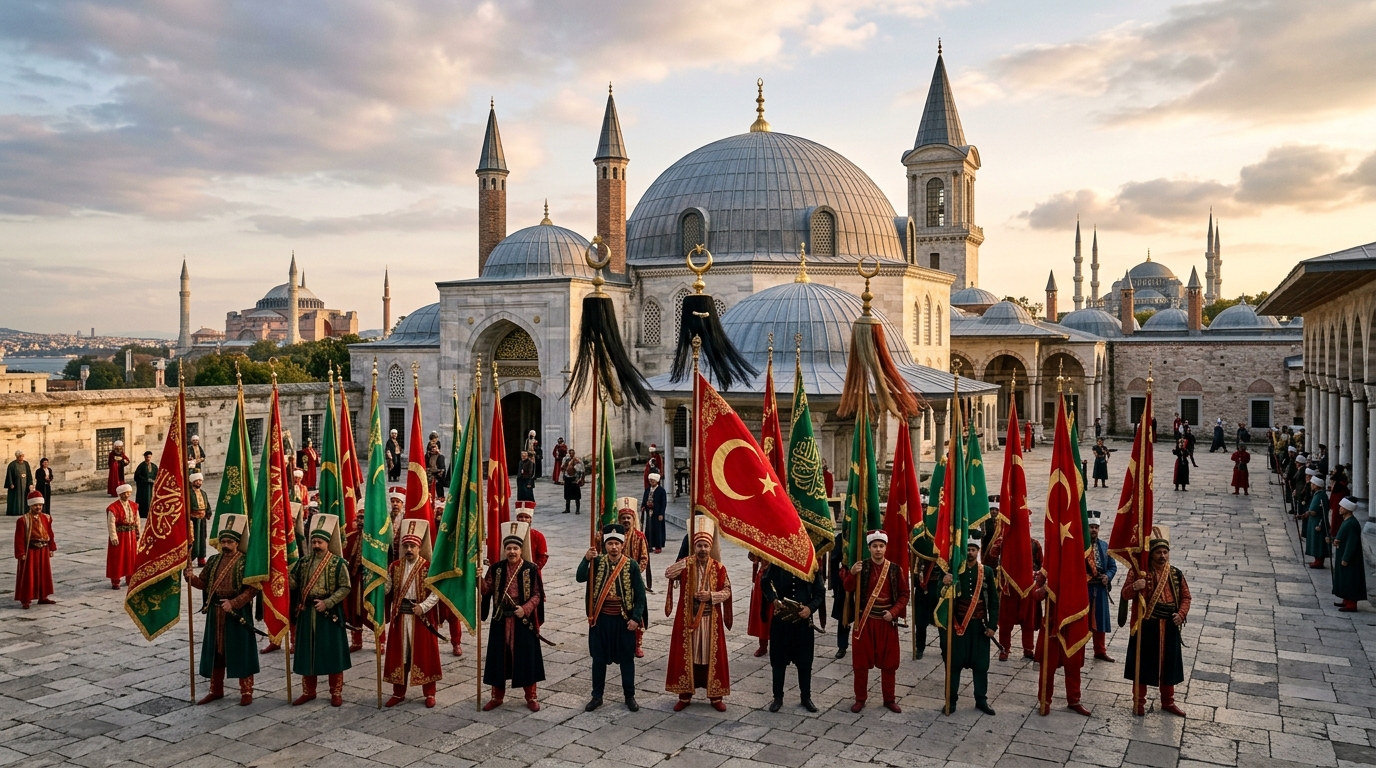
1. The Vexillological Universe of the Ottoman Empire
For over six centuries, from the rise of Osman I in 1299 to the dissolution of the Sultanate in 1922, the Ottoman Empire (the Sublime Porte) bridged three continents: Southeastern Europe, Western Asia, and North Africa. In contrast to Western European heraldry—which was rigidly organized around coats of arms, aristocratic quarterings, and Christian cross geometry—Ottoman vexillology evolved from ancient Central Asian nomadic steppe traditions, Islamic holy scripture, and imperial administrative ceremonialism.
Ottoman vexillology was deeply decentralized and functionally specialized. The empire utilized an intricate hierarchy of banners: sacred religious standards (Sancak-i Serif), imperial sultanic flags bearing the sovereign’s calligraphic signature (Tugra), specialized military brigade banners belonging to the elite Janissary corps (Ortas), and maritime naval ensigns that dominated the Mediterranean and Black Seas.
2. The Tug: Steppe Nomadic Horse-Tail Standards
Long before the Ottomans adopted silk flags, their Turkic ancestors on the steppes of Central Asia commanded armies through the Tug (or Bunchuk). A Tug was a tall wooden staff crowned by a gilded crescent moon or copper ball, from which hung one or more dyed horse-tails or yak-tails. In ancient steppe culture, horses were the ultimate symbols of mobility, pastoral wealth, and martial power.
Inside the Ottoman administrative hierarchy, the number of horse-tails displayed on a dignitary’s Tug precisely codified his military and political rank:
3. Sancak-i Serif: The Sacred Standard of the Prophet
The supreme religious standard of the Ottoman state was the Sancak-i Serif (the Holy Banner of the Prophet Muhammad). According to Islamic tradition, this sacred green or black banner was originally fashioned from the turban or curtain of Aisha, the Prophet’s wife. When the Ottomans conquered Mamluk Egypt in 1517 under Sultan Selim I, the sacred relics of Islam—including the Prophet’s mantle, sword, and standard—were transferred to the Topkapi Palace in Istanbul.
The Sancak-i Serif was preserved in a golden chest inside the Chamber of Holy Relics. It was only brought forth during moments of supreme existential peril, when the Sultan declared a formal imperial Holy War (Cihad). Unfurling the banner in Istanbul summoned all able-bodied Muslim subjects across the empire to rally under the Caliph’s command.
4. Janissary Vexillology and the Sacred Cauldrons
The Janissaries (Yeniçeri), the Sultan’s elite standing infantry corps, possessed some of the most distinctive military heraldry in world history. Each Janissary regiment (orta) flew its own specialized triangular or swallow-tailed silk banner, frequently split along the fly into two long pennants.
Zulfiqar: The Double-Bladed Sword Banners
Many Janissary battle flags depicted Zulfiqar, the legendary bifurcated (two-bladed) sword given by the Prophet Muhammad to his cousin and son-in-law Ali ibn Abi Talib. The sword was embroidered in gold thread across crimson or green fields, bordered by the famous Quranic inscription: “La fata illa Ali, la sayfa illa Zulfiqar” (“There is no hero like Ali, there is no sword like Zulfiqar”). It served as a terrifying visual emblem of righteous martial justice.
The Kazan: When Overturning the Cauldron Meant Coup
Vexillologically, the ultimate totem of an orta was not a textile flag, but their massive copper cooking cauldron—the Kazan-i Serif. The cauldron symbolized the Sultan’s paternal duty to feed his loyal soldiers. When Janissaries were loyal, their officers paraded the Kazan with military fanfare; but when the Janissaries mutinied against a Sultan or Vizier, they marched into the Hippodrome and dramatically overturned their cauldrons (Kazan kaldirmak), signaling a bloody military coup d’état.
When reformist Sultan Mahmud II resolved to abolish the corrupt Janissary corps in June 1826, he hoisted the sacred Sancak-i Serif in Sultanahmet Square. Tens of thousands of loyal citizens and modern artillerymen rallied beneath the Prophet’s banner, bombarding the Janissary barracks and ending centuries of Janissary dominance in an event known to Ottoman history as the Vaka-i Hayriye (The Auspicious Incident).
5. The Star and Crescent: From Constantinople to Modern Islam
Today, the Star and Crescent is globally recognized as the paramount symbol of the Islamic faith; however, its vexillological origin is deeply ancient, pre-dating Islam by over a thousand years. In antiquity, the crescent moon was the municipal emblem of the ancient Greek city of Byzantium (later Constantinople), associated with the lunar goddess Artemis/Hecate.
According to Ottoman founding mythology, Osman I (the founder of the dynasty) had a legendary dream while staying at the home of holy man Sheikh Edebali: a luminous crescent moon arose from Edebali’s chest and entered Osman’s heart, sprouting a colossal plane tree whose branches shaded three continents. Following the Ottoman conquest of Constantinople in 1453, Sultan Mehmed II integrated the ancient municipal crescent into Ottoman heraldry.
The Tanzimat Reforms and the 1844 Flag Standard
For centuries, Ottoman flags varied between green (symbolizing the Caliphate and Islam) and red (symbolizing the Sultanate and military authority), adorned with various crescents, suns, or eight-pointed stars. However, during the modernizing Tanzimat era under Sultan Abdulmejid I, the empire codified its first universal modern national flag in 1844: a brilliant crimson field charged with a centered white crescent moon and a sharp, five-pointed white star. This 1844 standard became the direct structural predecessor of the modern flag of the Republic of Turkey, established in 1923 by Mustafa Kemal Atatürk.
6. The Global Legacy Across Muslim National Banners
Because the Ottoman Empire served as the seat of the Islamic Caliphate for four centuries, the Ottoman star and crescent motif was subsequently adopted by newly independent Muslim nations across Asia, Africa, and the Middle East as a universal symbol of Islamic sovereignty and identity:
- Tunisia: Adopted in 1827 under Hussein II Bey, featuring a white circle with red star and crescent, directly derived from the Ottoman naval ensign.
- Pakistan: Adopted the white crescent and star on a deep green field in 1947, representing progress, light, and religious freedom for the Muslim majority and religious minorities.
- Algeria, Libya, Mauritania, Azerbaijan, and Malaysia: Each integrated variations of the Ottoman crescent and star to assert Islamic heritage and national sovereignty.
7. Frequently Asked Questions
What was the Sultan’s Tugra, and was it flown on flags?
The Tugra was the complex, calligraphic imperial monogram of the reigning Sultan, combining his name, his father’s name, and the honorific title “al-Muzaffar Da’ima” (“Always Victorious”). It was embroidered in gold thread upon the personal imperial standards flown over the imperial palace, the Sultan’s imperial yacht, and military headquarters.
Why were some Ottoman flags green while others were red?
In the classical Ottoman color philosophy, Green represented Islamic religious authority, the Caliphate, and holy pilgrimage, while Red represented administrative sovereignty, secular imperial law (Kanun), and martial combat power. Civil merchant shipping was frequently divided along these lines: Muslim merchant vessels flew a green-red-green triband, while Jewish and Christian subjects flew blue and yellow tribands.
8. Barbarossa and the Naval Heraldry of the Ottoman Fleet
Under legendary admirals such as Hayreddin Barbarossa (Kapudan Pasha under Sultan Suleiman the Magnificent), the Ottoman navy transformed the Mediterranean into an Ottoman lake. Barbarossa’s personal naval flagship banner—preserved today in Istanbul’s Naval Museum—is one of the most magnificent religious and military banners ever woven.
Dyed green silk embroidered in silver and gold calligraphy, Barbarossa’s standard features four distinct quadrants of sacred inscriptions:
- The top features the famous Quranic verse from Surah As-Saff (61:13): “Nasrun mina Allahi wa fathun qarib” (“Victory from Allah and an eminent conquest”).
- Across the middle lies the legendary double-bladed sword Zulfiqar, surrounded by the names of the four Rightly Guided Caliphs: Abu Bakr, Umar, Uthman, and Ali.
- At the bottom rests the Seal of Solomon (the six-pointed star, known in Islamic tradition as Khatam Sulayman), an ancient protective talisman against maritime storms and sea perils.
The Mehter Military Band Standards
No Ottoman army marched without the Mehter, the world’s oldest military marching band. Flanked by towering horse-tail Tug standards and crimson silk flags, the Mehter played colossal kettle drums (Kös) mounted on the backs of camels. The thunderous acoustics, paired with the sight of hundreds of rippling crescent standards, exerted immense psychological terror upon European fortress garrisons during the sieges of Rhodes, Belgrade, and Vienna.
Global Vexillological Preservation: Institutional Archives, Legal Protections, and Heraldic Authorities
To preserve national standards and historic banners for future generations, sovereign nations maintain dedicated statutory bodies, heraldic colleges, and state archives. Studying how international institutions document, restore, and legally protect flag heritage reveals the profound cultural reverence accorded to vexillological artifacts worldwide.
A. The College of Arms and the Court of the Lord Lyon
In the United Kingdom and the Commonwealth, the granting and regulation of flags is administered by the College of Arms in London (established by King Richard III in 1484) and the Court of the Lord Lyon in Edinburgh, Scotland. In Scotland, the Lord Lyon King of Arms possesses judicial power under ancient acts of the Scottish Parliament: displaying an unauthorized or historically defective coat of arms or banner on a public building is a criminal offense, prosecutable in the Lyon Court.
B. The Flag Research Center and FIAV International Congresses
Founded in 1962 by Dr. Whitney Smith, the Flag Research Center pioneered the scientific methodology of modern vexillology. Together with the Fédération Internationale des Associations Vexillologiques (FIAV), uniting over fifty regional associations across six continents, scholars convene biennially at the International Congress of Vexillology (ICV) to debate historical flag discoveries, coordinate flag conservation science, and standardize digital vexillological taxonomy.
C. Constitutional Flag Protection Laws and Degradation Etiquette
National flag codes around the world mandate specific dignified procedures for retiring soiled or damaged standards. In the United States (4 U.S.C. § 8k), when a flag is no longer a fitting emblem for display, it should be destroyed in a dignified manner, preferably by burning during a respectful solemn ceremony. Similarly, the Flag Code of India (2002) mandates that damaged national flags must be destroyed privately in their entirety, preferably by burning or burying in accordance with sovereign dignity.
- Always hoist the national flag briskly to the peak and lower it ceremoniously with slow deliberation.
- Never allow a sovereign flag to touch the ground, floor, water, or objects beneath it.
- When flown alongside regional or corporate banners, the sovereign national flag always occupies the supreme position of honor.
- Never display a national flag upside down, except as a signal of dire medical or navigational distress.
- During half-mast mourning, first hoist the flag to the peak for an instant before lowering to half-staff.
- Illumination is required if a flag is displayed outdoors during the hours of darkness.
- Do not place advertising slogans, signatures, or unauthorized badges directly upon the field of a national standard.
- Store flags folded neatly in clean, moisture-free cases to prevent mold, fabric oxidation, and pest damage.
- When multiple foreign flags fly together, each must fly on its own staff of equal height and identical scale.
- Retire worn, faded, or frayed flags privately with dignity and reverence.