1. The Ancien Régime: The Reign of Royal White
Prior to July 1789, the Kingdom of France possessed no “national flag” in the modern democratic sense. Under the absolute monarchy of the House of Bourbon, France belonged to the King, and the King’s heraldic livery was the exclusive standard of the realm. The royal French standard was the Drapeau Blanc—a field of pure white silk, frequently semé with golden fleurs-de-lis and crowned with the royal coat of arms.
White was the sacred dynastic color of the Bourbons, representing divine right monarchy, absolute royal supremacy, and Roman Catholic purity. Common citizens had no relationship to this banner; it fluttered over royal châteaux, military fortresses, and naval frigates as a visual manifestation of subjugation to the monarch. When the French Revolution erupted in the summer of 1789, the dismantling of feudal absolute power required the total destruction of royal heraldry and the creation of an entirely new visual language of popular sovereignty.
2. The Cockades of Paris: July 1789
The story of the Tricolor begins not in an assembly hall, but in the chaotic streets of Paris on July 12, 1789, two days before the storming of the Bastille. Revolutionary orator Camille Desmoulins, standing atop a table outside the Café de Foy in the gardens of the Palais-Royal, leaped before the enraged crowds and plucked a green leaf from a chestnut tree, pinning it to his hat as a rallying badge (cocarde) of hope and rebellion.
However, green was quickly abandoned when citizens remembered it was the livery color of the hated, reactionary Comte d’Artois (the King’s conservative brother). Instead, the newly organized Parisian National Guard, under the leadership of the liberal hero Marquis de Lafayette, adopted the historic municipal colors of Paris: Blue and Red. Blue honored Saint Martin of Tours, and Red honored the blood of Saint Denis, the patron saints of Paris.
Lafayette’s Synthesis: Adding the Royal White
On July 17, 1789, three days after the Bastille fell, King Louis XVI traveled from Versailles to Paris to meet the victorious revolutionary citizens at the Hôtel de Ville. Lafayette presented the King with a cockade uniting the Parisian Red and Blue with the royal White pinned in the center. Lafayette famously proclaimed:
“I bring you, Sire, a cockade that will make the tour of the world, and an institution that must lead to the complete triumph of liberty.”
Lafayette’s initial synthesis was constitutional and reformist: the white of the King was symbolically encircled and restrained by the blue and red of the people of Paris, representing a constitutional monarchy governed by the will of the nation.
3. The Decree of 27 Pluviôse, Year II (1794)
By late 1792, the constitutional monarchy had collapsed. Louis XVI was guillotined on January 21, 1793, and the First French Republic declared war against all the royal coalitions of Europe. Retaining any white field on naval standards was unacceptable to the National Convention.
On 27 Pluviôse, Year II (February 15, 1794), the revolutionary government passed the historic decree establishing the definitive national flag of France:
“The national flag shall be formed of the three national colors, disposed in three equal bands, placed vertically, so that the blue is attached to the staff, the white in the middle, and the red floating in the air.”
The vertical arrangement was engineered by neoclassical master painter Jacques-Louis David, an ardent Jacobin and close associate of Maximilien Robespierre. David recognized that vertical stripes created an imposing, dynamic visual presence when unfurled, cleanly separating the French standard from the horizontal stripes of the Dutch and Austrian empires.
4. The European Firestorm: The Spread of the Tricolor
As Napoleon Bonaparte’s revolutionary armies marched across Europe, they carried the concept of the tricolor across every conquered territory. Monarchies and principalities dissolved, replaced by “Sister Republics” that eagerly adopted vertical tricolors modeled after France:
- The Italian Tricolore (1797): Napoleon formed the Cispadane Republic in Northern Italy, which adopted green, white, and red stripes. Green replaced blue as the color of Milanese civic militias and the fertile Po River valley. Today, it serves as the sovereign flag of the Republic of Italy.
- The Batavian Republic (1795): The Netherlands transitioned its ancient horizontal tricolor into revolutionary alignment.
- The Helvetic Republic (1798): Switzerland briefly adopted a green-red-yellow tricolor under French guidance before returning to its historic cross.
- Belgium (1830): When Belgium revolted against Dutch rule in 1830, it adopted the vertical tricolor format (Black, Yellow, Red) to assert its national independence.
During the February Revolution of 1848, socialist workers demanded that France abandon the Tricolor and adopt the pure Red Flag of proletarian revolution. Poet and statesman Alphonse de Lamartine defended the Tricolor in a historic speech before the Paris mobs: “The red flag has only made the tour of the Champ de Mars, trailed in the blood of citizens in 1791 and 1793; but the tricolor flag has made the tour of the world with the name, the glory, and the liberty of France!” The crowd cheered, and the Tricolor was preserved.
5. Delacroix’s Masterpiece: Liberty Leading the People
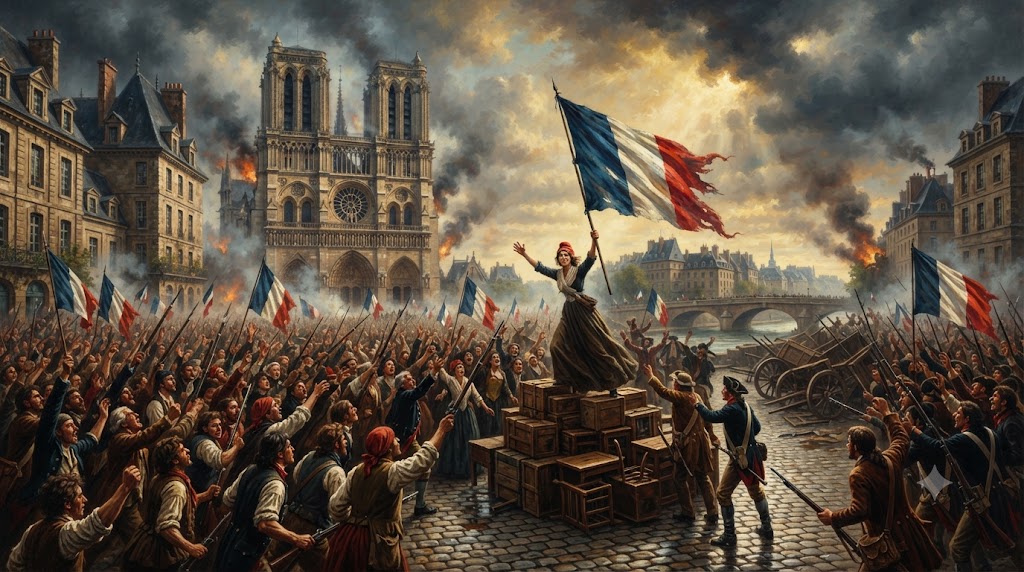
In 1830, the French people revolted against the reactionary Bourbon king Charles X during the Three Glorious Days (Les Trois Glorieuses), permanently overthrowing the royal white flag and reclaiming the Tricolor. Neoclassical and Romantic artist Eugène Delacroix immortalized this historic triumph in his iconic 1830 painting: “Liberty Leading the People” (La Liberté guidant le peuple).
In the painting, the female personification of the French Republic—Marianne—bare-breasted and wearing the Phrygian cap of emancipation, strides over the barricades holding a musket with bayonet in her left hand and raising the Drapeau Tricolore triumphantly in her right. The painting cemented the Tricolor as the eternal international symbol of democratic rebellion against authoritarian tyranny.
6. Frequently Asked Questions
Why did President Emmanuel Macron change the blue in 2020?
In July 2020, President Emmanuel Macron directed the Elysee Palace to darken the blue stripe of the French flag from European Union Marian Blue (Pantone Reflex Blue) back to the historic Navy Blue (Pantone 282 C) chosen by Jacques-Louis David in 1794. The shift reasserted historic revolutionary naval heritage and created a more solemn aesthetic on television broadcasts.
Why are the stripes on French naval ensigns unequal?
On warships of the French Navy (Marine Nationale), the vertical stripes measure Blue 30%, White 33%, and Red 37%. This intentional optical correction accounts for fabric flutter: because the trailing red edge flaps rapidly in ocean winds, making it appear narrower to the eye, the wider red stripe ensures that all three bands appear perfectly equal to observers watching from distance.
7. The War in the Vendée: The White Banner Resists
The triumph of the French Tricolor was not universally welcomed across France. In Western France, the royalist and devoutly Catholic peasants of the Vendée launched a ferocious armed counter-revolution against the revolutionary Paris government in 1793. Rejecting the Tricolor as a symbol of atheism, regicide, and terror, the Catholic and Royal Army fought under the ancient royal white banner emblazoned with the Sacred Heart of Jesus (Sacré-Cœur) and the motto “Dieu et le Roi” (“God and the King”).
The brutal civil war in the Vendée highlighted how deeply flags divide human allegiances. While Parisian republicans viewed the Tricolor as the dawn of universal freedom, royalist counter-revolutionaries viewed the white flag as the sacred symbol of ancestral faith, martyr kings, and eternal tradition. The total defeat of the Vendée ensured the permanent supremacy of the Tricolor in French history.
8. The 1871 Paris Commune and the Red Flag Challenge
In 1871, following France’s defeat in the Franco-Prussian War, socialist and working-class rebels seized Paris and established the revolutionary Paris Commune. For seventy-two days, the Commune discarded the national Drapeau Tricolore, declaring it tainted by bourgeois capitalism and imperial wars. Above the Hôtel de Ville, the Communards hoisted the Pure Red Flag (Le Drapeau Rouge), celebrating it as the universal standard of the international working class and the global federation of free peoples.
When the French regular army under Adolphe Thiers crushed the Commune during the bloody “Bloody Week” (Semaine Sanglante), the Tricolor was decisively restored as the sovereign banner of the Third French Republic, striking a permanent constitutional compromise between republican democracy and national law and order.
9. The Global Republican Legacy of the Tricolor
The French Tricolor gave the modern world its most powerful political visual template. From the emerald-white-orange of Ireland and the green-white-red of Italy to the vertical tricolors of Mexico, Senegal, and Nigeria, vertical bands remain the international visual shorthand for popular sovereignty, constitutional rights, and national independence.
Global Vexillological Preservation: Institutional Archives, Legal Protections, and Heraldic Authorities
To preserve national standards and historic banners for future generations, sovereign nations maintain dedicated statutory bodies, heraldic colleges, and state archives. Studying how international institutions document, restore, and legally protect flag heritage reveals the profound cultural reverence accorded to vexillological artifacts worldwide.
A. The College of Arms and the Court of the Lord Lyon
In the United Kingdom and the Commonwealth, the granting and regulation of flags is administered by the College of Arms in London (established by King Richard III in 1484) and the Court of the Lord Lyon in Edinburgh, Scotland. In Scotland, the Lord Lyon King of Arms possesses judicial power under ancient acts of the Scottish Parliament: displaying an unauthorized or historically defective coat of arms or banner on a public building is a criminal offense, prosecutable in the Lyon Court.
B. The Flag Research Center and FIAV International Congresses
Founded in 1962 by Dr. Whitney Smith, the Flag Research Center pioneered the scientific methodology of modern vexillology. Together with the Fédération Internationale des Associations Vexillologiques (FIAV), uniting over fifty regional associations across six continents, scholars convene biennially at the International Congress of Vexillology (ICV) to debate historical flag discoveries, coordinate flag conservation science, and standardize digital vexillological taxonomy.
C. Constitutional Flag Protection Laws and Degradation Etiquette
National flag codes around the world mandate specific dignified procedures for retiring soiled or damaged standards. In the United States (4 U.S.C. § 8k), when a flag is no longer a fitting emblem for display, it should be destroyed in a dignified manner, preferably by burning during a respectful solemn ceremony. Similarly, the Flag Code of India (2002) mandates that damaged national flags must be destroyed privately in their entirety, preferably by burning or burying in accordance with sovereign dignity.
- Always hoist the national flag briskly to the peak and lower it ceremoniously with slow deliberation.
- Never allow a sovereign flag to touch the ground, floor, water, or objects beneath it.
- When flown alongside regional or corporate banners, the sovereign national flag always occupies the supreme position of honor.
- Never display a national flag upside down, except as a signal of dire medical or navigational distress.
- During half-mast mourning, first hoist the flag to the peak for an instant before lowering to half-staff.
- Illumination is required if a flag is displayed outdoors during the hours of darkness.
- Do not place advertising slogans, signatures, or unauthorized badges directly upon the field of a national standard.
- Store flags folded neatly in clean, moisture-free cases to prevent mold, fabric oxidation, and pest damage.
- When multiple foreign flags fly together, each must fly on its own staff of equal height and identical scale.
- Retire worn, faded, or frayed flags privately with dignity and reverence.