FLAG ATLAS / NATIONAL FLAGS EXPLAINED
Every Flag Tells a Story
Explore the history, colors, shapes, and national symbols that make flags powerful expressions of identity.
HISTORY • SYMBOLISM • CULTURE • DESIGN
National flags are among the most recognizable symbols in the world.
They appear outside government buildings, at international sporting events, on ships, in classrooms, and during national celebrations. A flag can identify a country without requiring a single written word.
Yet national flags look remarkably different from one another.
Some contain simple horizontal stripes. Others feature stars, crosses, crescents, animals, plants, or complex coats of arms. Their colors range from familiar combinations of red, white, and blue to distinctive arrangements of green, yellow, black, orange, and other shades.
These differences are rarely accidental. Many flag designs reflect important historical events, cultural traditions, political movements, or ideas about national identity.
However, flag symbolism is not always straightforward. The same color can have different meanings in different countries, and some commonly repeated explanations are later interpretations rather than the original reasons for a design.
This guide explores why national flags use different colors and symbols, how their designs developed, and what well-known flags can teach us about the countries they represent.
What Is the Purpose of a National Flag?
A national flag is a visual symbol used to represent a country.
It can communicate national identity, political sovereignty, historical continuity, and shared cultural traditions.
Flags also serve practical purposes.
Historically, banners and flags helped identify armies, rulers, ships, and political groups. Their colors and shapes made them recognizable from a distance.
As modern states developed, national flags became increasingly important symbols of government and citizenship.
Today, they are used in diplomacy, international organizations, public ceremonies, and everyday civic life.
Although flags often inspire patriotic feelings, their meanings can also be debated. Different communities may interpret a national symbol through different historical or political experiences.
Did You Know?
The study of flags is called vexillology.
Vexillology examines flags, their history, design, symbolism, development, and use. The term comes from the Latin word vexillum, associated with a type of Roman military standard.
Why Do National Flags Use Different Colors?
Colors are among the most important elements of flag design.
They make flags visually distinctive and may communicate ideas connected to history, religion, geography, or national values.
However, there is no universal dictionary that assigns one fixed meaning to each color.
Red does not always mean courage, and green does not always represent nature. The meaning depends on the flag’s history and the explanations associated with its design.
Red: Courage, Sacrifice, and Historical Identity
Red appears on many national flags, including those of Canada, Japan, China, Turkey, and the United Kingdom.
In some national traditions, red is associated with bravery, sacrifice, or struggles for independence.
In other cases, it comes from older dynastic, military, or political symbols.
For example, the red field of Turkey’s flag belongs to a historical flag tradition associated with the Ottoman period.
Japan’s flag uses a red circular sun symbol on a white background. The central design refers to the sun rather than a general meaning assigned to the color red.
White: Peace, Tradition, or Visual Contrast
White is another frequently used flag color.
It can symbolize peace, honesty, or unity in some interpretations, but it also serves an important visual function.
White creates strong contrast against darker colors, making patterns and symbols easier to recognize.
The Japanese flag provides a familiar example of a simple red-and-white design.
Switzerland also uses a white cross against a red field.
The historical origins of these designs matter more than any general color association.
Blue: Historical Traditions and National Ideals
Blue appears prominently in the flags of the United States, Australia, France, Greece, and many other countries.
Depending on the national context, blue may be associated with historical institutions, political ideals, or geographic imagery.
For example, the blue field of Australia’s flag contains the Union Jack, the Commonwealth Star, and the Southern Cross constellation.
Its symbolism is connected to the country’s history and geography rather than a single universal interpretation of blue.
Green: Religion, Land, and Cultural Identity
Green is common in flags across Africa, the Middle East, and other regions.
It has associations with Islam in many cultural and historical contexts.
In other flags, green may be connected to land, agriculture, vegetation, or political history.
For example, the green field of Saudi Arabia’s flag appears with the Islamic declaration of faith and a sword.
Meanwhile, green in other national flags may have entirely different origins.
Yellow and Gold: Distinction, Heritage, and Natural Wealth
Yellow and gold appear in flags such as those of Brazil, Germany, Colombia, and Sweden.
In some countries, these colors are associated with natural resources, historical heraldry, or national traditions.
Brazil’s yellow diamond is often associated with the country’s historical imperial symbolism, while popular interpretations also connect it with natural wealth.
Sweden’s yellow cross on a blue background belongs to the Nordic cross tradition.
Black: History, Identity, and Political Movements
Black appears on the flags of Germany, Kenya, Jamaica, and several other nations.
Its meaning varies widely.
In Kenya’s flag, black represents the people of Kenya within the flag’s established symbolism.
Germany’s black, red, and gold colors are associated with the country’s political history and movements for unity and freedom.
These examples demonstrate why national context is essential when interpreting flag colors.
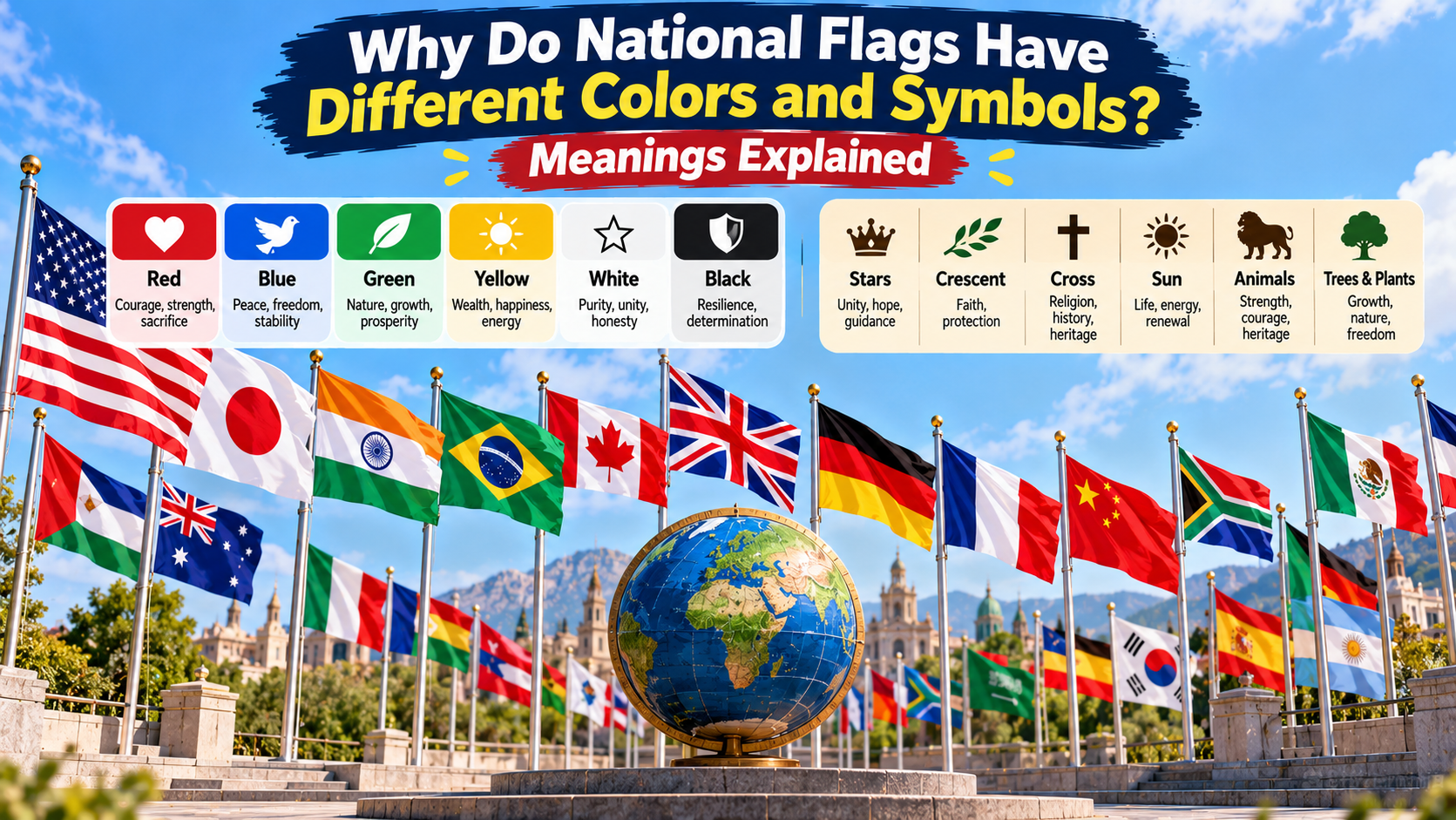
Common Flag Colors and Their Possible Meanings
The following table summarizes associations frequently encountered in flag symbolism. These meanings are illustrative, not universal rules.
| Color | Possible Associations | Example Countries |
|---|---|---|
| Red | Historical identity, sacrifice, courage | Canada, Turkey, Japan |
| White | Peace, unity, historical symbols | Japan, Switzerland, Finland |
| Blue | History, ideals, geographic imagery | Australia, Greece, France |
| Green | Religion, land, political identity | Saudi Arabia, Nigeria, Brazil |
| Yellow / Gold | Heraldry, heritage, natural wealth | Brazil, Sweden, Colombia |
| Black | History, identity, political traditions | Kenya, Germany, Jamaica |
Why Do Some National Flags Have Stars?
Stars are among the most recognizable symbols used on national flags.
They can represent political units, geographic features, historical ideas, or national identity.
However, their meaning varies from country to country.
United States: Fifty Stars
The flag of the United States contains 50 white stars arranged on a blue field.
Each star represents one of the country’s 50 states.
The flag also contains 13 alternating red and white stripes, representing the original 13 colonies.
This makes the design a direct visual reference to the country’s political structure and history.
Australia: Stars and the Southern Sky
Australia’s flag contains the Commonwealth Star and five stars representing the Southern Cross constellation.
The Southern Cross is an important feature of the southern night sky.
The Commonwealth Star has seven points, representing the six Australian states and the territories collectively.
China: One Large Star and Four Smaller Stars
China’s national flag contains one large yellow star and four smaller yellow stars on a red background.
The design is associated with the leadership of the Communist Party of China and the unity of the Chinese people within the political symbolism of the flag.
Its meaning differs considerably from the stars on the American or Australian flags.
Flag Symbolism Insight
A star does not always represent a state.
Stars can symbolize political units, national unity, historical movements, or constellations. Their meaning must be understood through the history of the individual flag.
Why Do Some National Flags Have Crosses?
Crosses appear on numerous national flags, particularly in Europe.
Some originate from Christian symbolism, while others reflect historical political and cultural traditions.
The Nordic cross is especially recognizable.
Flags of Denmark, Sweden, Norway, Finland, and Iceland use an off-center cross extending toward the edges of the flag.
These designs share a regional visual tradition, although their colors and individual histories differ.
Denmark’s Dannebrog
Denmark’s flag is known as the Dannebrog.
It features a white Nordic cross on a red background.
It is widely recognized as one of the oldest continuously used national flag designs.
Its traditional origin story connects the flag to a medieval battle, although that legend should not be treated as a fully established historical account.
The United Kingdom’s Union Flag
The Union Flag, commonly called the Union Jack, combines crosses associated with Saint George, Saint Andrew, and Saint Patrick.
Its design reflects the historical political unions that shaped the United Kingdom.
The flag demonstrates how multiple historical symbols can be combined into one national design.
What Does the Crescent Symbol Mean on Flags?
The crescent is another familiar symbol on national flags.
It appears on flags including those of Turkey, Pakistan, Tunisia, and Algeria.
The crescent and star are widely associated with Islam in modern contexts, although their historical use is broader and more complex.
The Ottoman Empire played an important role in the development and spread of crescent-and-star symbolism.
Not every crescent-bearing flag has the same origin or official interpretation.
For example, Pakistan’s flag includes a white crescent and star on a green field, along with a vertical white stripe.
Its established symbolism connects the crescent and star with progress and light, while the white stripe represents religious minorities.
The precise meanings of such symbols are best understood through official national explanations and historical context.
Why Do Some Flags Feature Animals?
Animals have appeared in heraldry, royal emblems, military banners, and cultural symbolism for centuries.
National flags sometimes preserve these traditions.
Animal symbols may represent strength, freedom, cultural heritage, or historical authority.
Mexico: The Eagle and the Snake
Mexico’s national flag contains a central coat of arms featuring an eagle holding a snake while standing on a cactus.
The image is connected to the founding traditions of Tenochtitlan, the capital of the Aztec Empire.
It is one of the most distinctive examples of historical and cultural imagery incorporated into a national flag.
Albania: The Double-Headed Eagle
Albania’s flag features a black double-headed eagle on a red background.
The eagle is connected to historical heraldry and Albanian national identity.
The design is especially recognizable because of its strong contrast and distinctive central symbol.
Bhutan: The Dragon
Bhutan’s national flag features a white dragon across a diagonally divided yellow and orange field.
The dragon is associated with the country’s identity as Druk Yul, often translated as the Land of the Thunder Dragon.
Its design reflects important cultural and religious traditions.
Plants and Trees as National Flag Symbols
Not all national symbols involve stars, crosses, or animals.
Some countries use plants and trees to communicate cultural or geographic identity.
Canada’s Maple Leaf
Canada’s national flag features a red maple leaf centered on a white square between two red vertical bands.
The maple leaf had been associated with Canadian identity long before the current flag was adopted in 1965.
Its simple design makes it easy to recognize internationally.
Lebanon’s Cedar Tree
Lebanon’s flag features a green cedar tree against a white central band, with red bands above and below.
The cedar has deep historical and cultural significance in the region.
It is an important symbol of Lebanese identity and heritage.
Why Are Some Flags Made of Stripes?
Stripes are among the simplest and most effective flag design elements.
They divide a flag into recognizable sections and can carry historical or political meaning.
Horizontal and vertical stripes appear on flags throughout the world.
France’s flag uses three vertical bands of blue, white, and red.
Germany’s flag uses three horizontal bands of black, red, and gold.
Italy’s flag features vertical green, white, and red bands.
Although these flags use simple arrangements, their historical origins are different.
Some striped designs emerged from revolutionary movements, while others developed from older political or regional traditions.
The orientation of the stripes does not have one universal meaning.
Why Do Some Countries Have Similar Flags?
Several national flags look surprisingly similar.
This often reflects shared historical influences, regional traditions, or political connections.
The Pan-African Colors
Red, yellow, and green appear in many African national flags.
These colors have strong historical associations with Ethiopia and later Pan-African movements.
Different countries adopted related combinations while developing their own national symbolism.
The Pan-Arab Colors
Black, white, green, and red appear in several Arab national flags.
These colors are associated with historical Arab dynasties and movements for Arab unity and independence.
The flags of Jordan, the United Arab Emirates, Kuwait, and other countries use different arrangements of these colors.
The Nordic Cross Tradition
Denmark, Sweden, Norway, Finland, and Iceland share a recognizable cross-based flag design.
Their common visual structure reflects regional historical and cultural connections.
Each country nevertheless maintains its own distinct colors and national flag history.
How National Flags Change Over Time
National flags are not always permanent.
Countries may adopt new flags after independence, constitutional changes, political transitions, or major historical events.
Sometimes a new design replaces symbols associated with an earlier government.
In other cases, countries preserve older symbols to emphasize historical continuity.
South Africa adopted its current national flag in 1994, during the country’s transition to democracy.
The design became closely associated with a new political era.
Canada adopted its current maple leaf flag in 1965, replacing the Canadian Red Ensign as the national flag.
These examples demonstrate how flag design can become part of broader discussions about national identity and historical change.
What Makes a National Flag Easy to Recognize?
Some flags are visually simple, while others contain detailed emblems.
Simple designs can be easier to reproduce and identify at a distance.
Strong contrast between colors also helps distinguish shapes and symbols.
However, national flag design is not only a matter of modern graphic design principles.
Historical meaning, legal requirements, cultural importance, and public attachment can all influence a flag’s appearance.
A detailed national emblem may be difficult to reproduce at a small size, yet remain important because of its historical significance.
Therefore, evaluating a national flag requires more than judging its visual simplicity.
Design Observation
Recognition and meaning are equally important.
A flag must function as a visible symbol, but its historical and cultural significance can be just as important as its graphic simplicity.
How to Understand the Meaning of Any National Flag
If you want to learn the meaning behind a particular country’s flag, begin with its history.
Find out when the current design was adopted and whether it replaced an earlier flag.
Next, identify the colors, shapes, and central symbols.
Look for official descriptions from national institutions, government publications, or established historical references.
Compare these explanations with popular interpretations.
Be careful with claims that assign a specific meaning to every color without historical evidence.
Some flags have clearly documented official symbolism, while others developed gradually through historical use.
Understanding this distinction can make flag research more accurate and interesting.
Frequently Asked Questions About National Flags
Why do countries have different national flags?
Countries develop different flag designs because of their unique histories, political traditions, cultural symbols, and national identities.
Do flag colors have the same meaning everywhere?
No. Colors may have different meanings depending on the country, historical period, and official interpretation.
Why are stars common on national flags?
Stars can represent states, national unity, political ideas, or constellations. Their meanings vary between countries.
What does a cross on a national flag represent?
Many crosses have Christian or historical origins, but their specific significance depends on the flag’s development and national traditions.
Why do some countries use similar flag colors?
Similar colors can reflect shared regional history, political movements, cultural traditions, or historical relationships.
Can a country change its national flag?
Yes. Countries may adopt new flags following independence, political transitions, or other major historical developments.
What is the study of national flags called?
The study of flags is called vexillology. It includes their design, history, symbolism, and use.
Final Thoughts
National flags are much more than combinations of colors and shapes.
They are visual expressions of history, identity, and cultural tradition.
Red, white, blue, green, yellow, and black may appear on flags across the world, but their meanings are shaped by individual national experiences.
Stars can represent states or constellations. Crosses may reflect religious and historical traditions. Crescents, animals, plants, and other symbols can communicate distinctive aspects of national heritage.
Some flags preserve centuries-old imagery, while others mark relatively recent political changes.
The most interesting way to explore a national flag is to look beyond its appearance and investigate the events and ideas behind its design.
Every flag has a history, and understanding that history helps explain why the world’s national flags are so diverse.
Explore the World Through Flags
Different designs. Different histories. A shared language of identity.
The next time you see a national flag, look closely at its colors and symbols. They may reveal a fascinating story about the country behind it.