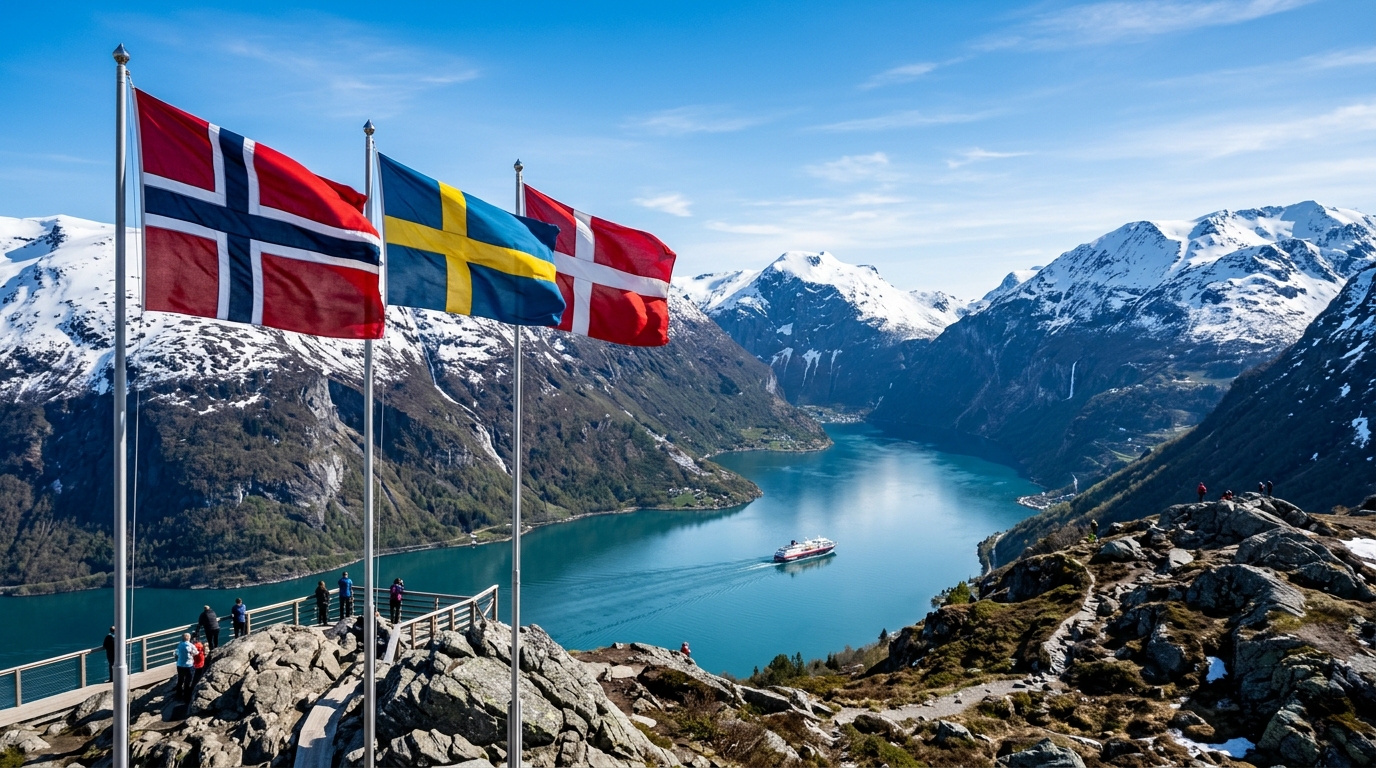
1. The Genesis of the Scandinavian Cross Standard
Few geographic regions in the world exhibit the vexillological cohesion seen in Northern Europe. Across five sovereign nations—Denmark, Sweden, Norway, Finland, and Iceland—and numerous autonomous territories including the Faroe Islands, Aland, and Greenland’s cultural neighbors, the visual landscape is defined by the distinctive Nordic Cross (also known as the Scandinavian Cross). Characterized by an asymmetric cross whose vertical bar is shifted toward the hoist side, this design represents a profound fusion of medieval Christian iconography, Scandinavian maritime prowess, and regional solidarity.
The structural genius of the Nordic Cross lies in its off-center alignment. When a flag hangs motionless against a flagpole in still air, a centered cross appears visually balanced; however, when hoisted high in coastal winds, the outer fly portion ripples rapidly while the hoist remains relatively static. By shifting the vertical bar toward the hoist, vexillographers compensated for wind-flutter dynamics, ensuring that the intersection of the cross remains readily identifiable and optically centered to observers watching from ships or distant shores.
2. Dannebrog: The Oldest Continuously Used National Flag
Every Nordic cross flag traces its ancestry directly to the Danish national flag, the Dannebrog (“Cloth of the Danes”). According to historical tradition and national legend, the Dannebrog descended miraculously from heaven during the Battle of Lyndanisse (modern-day Tallinn, Estonia) on June 15, 1219. King Valdemar II was leading a crusade against pagan Estonians when Danish troops began retreating under ferocious counterattacks. As Archbishop Sunesen raised his arms in prayer, a crimson banner bearing a clean white cross drifted down through storm clouds, revitalizing Danish morale and turning defeat into historic victory.
Historical records verify the Dannebrog’s usage as early as the 14th century in the Gelre Armorial, earning Denmark the Guinness World Record for the oldest continuously used sovereign national flag. The stark contrast of pure silver/white (Argent) across blood red (Gules) set the template for all subsequent Scandinavian vexillology.
3. Mathematical Geometry and Grid Proportions
Although casual viewers perceive all Nordic flags as identical in pattern, their underlying mathematical grids are strikingly distinct. Each country’s flag law specifies exact segment lengths for the four outer rectangular fields and the cross arms:
The Swedish Grid (10:16)
Under the Swedish Flag Act of 1982, the proportions are divided vertically into segments of 4:2:4 (top field, cross width, bottom field) and horizontally into 5:2:9 (hoist field, cross width, fly field). This means the hoist fields are perfect 4×5 units, while the elongated fly fields measure 4×9 units, providing remarkable visual stability.
The Norwegian Tricolor Grid (16:22)
Designed in 1821 by parliamentarian Fredrik Meltzer, Norway introduced a dual-colored cross to reflect both its historical past with Denmark and its contemporary political union with Sweden. Vertically, the flag is divided into 6:1:2:1:6 (red, white, blue, white, red) and horizontally into 6:1:2:1:12. This creates an intricate fimbriated composition where the inner blue cross is half the width of the surrounding white border.
4. Chromatic Symbolism and Regional Landscape Metaphors
The color palettes of Nordic flags are intimately tethered to geographic landscapes, meteorological reality, and heraldic heritage:
- Sweden: King Gustav Vasa adapted the blue and gold colors in the 16th century from the ancient Swedish coat of arms, the Tre Kronor (Three Golden Crowns upon an Azure field). The colors simultaneously evoke the golden sun gleaming against clear Scandinavian skies.
- Finland: Poet Zachris Topelius celebrated the Finnish flag colors in 1854 as representing “the blue of our thousand lakes and the clean white snow of our northern winters.” When Finland gained independence from Soviet Russia in 1917, the blue cross on snow-white field emerged triumphant over older red-and-gold lion banners.
- Iceland: Iceland’s flag encapsulates its geology: mountain sky-blue field, glacial ice-white fimbriation, and volcanic lava-red cross. It serves as a visual map of the volcanic island situated in the North Atlantic.
Between 1844 and 1905, during the United Kingdoms of Sweden and Norway, both nations placed a shared union badge in the cantons of their flags. Because of its complex patchwork of Swedish blue-yellow and Norwegian red-white-blue diagonal wedges, citizens affectionately and mockingly named it Sildesalaten (“The Herring Salad”). Its removal in 1899 was celebrated as a milestone toward Norwegian full sovereignty.
5. Autonomous and Cultural Nordic Crosses
Beyond the five sovereign nations, several self-governing islands and regional cultural minorities employ the Nordic cross to affirm their Scandinavian heritage while asserting their unique local identity:
The Merkid of the Faroe Islands
The Faroese flag (Merkid) was conceived in 1919 by Faroese students in Copenhagen led by Jens Oliver Lisberg. It features a red cross fimbriated with azure on a white field. During World War II, when British forces occupied the Faroe Islands while Nazi forces occupied mainland Denmark, the British Admiralty officially recognized the Merkid for Faroese shipping to distinguish it from hostile Danish vessels.
The Flag of Aland
The Swedish-speaking autonomous region of Aland (part of Finland) flies a blue flag charged with a red cross bordered in yellow. The flag harmoniously blends the Swedish national colors (blue and yellow) with the Finnish coat of arms colors (red and gold), visually articulating the autonomous archipelago’s cultural and constitutional balance between both nations.
6. The Exception: Greenland’s Polar Sun Standard
Within the Nordic Council, Greenland stands out as the prominent member that deliberately chose not to adopt a Nordic cross. In 1985, Greenland held a national design competition. Rather than adopting an off-center Christian cross, Greenland approved a striking geometric design by native Inuit artist Thue Christiansen: two horizontal bands of white and red charged with a counterchanged off-center circular disc. The circle represents the Arctic polar sun sinking into and rising from the icy northern ocean, affirming Greenland’s distinct indigenous Inuit identity within the Danish realm.
7. Frequently Asked Questions
Why does the cross sit closer to the flagpole?
By shifting the cross toward the hoist, vexillographers corrected for the aerodynamic flutter that occurs at the fly end in open maritime winds. When flying at the masthead of a sailing vessel, an off-center cross appears optically centered to observers at sea, whereas a truly centered cross appears crammed toward the trailing edge.
Did any other European nations adopt Nordic Cross flags?
Yes. The United Kingdom’s Shetland and Orkney archipelagos officially adopted Nordic cross flags in 1969 and 2007 respectively, honoring their historical Norse heritage. Similarly, regions in France (such as Normandy’s historic Saint Olaf Cross), parts of Estonia, and various maritime organizations have proposed or utilized Nordic crosses.
8. The Saami Flag: The Indigenous Counterpoint to the Nordic Cross
While the Nordic Cross visually unifies the Scandinavian nation-states, the indigenous people of Northern Scandinavia—the Saami (inhabiting Sápmi across Norway, Sweden, Finland, and Russia)—chose a fundamentally different heraldic path. Adopted in 1986 during the 13th Nordic Saami Conference in Are, Sweden, the Saami flag was designed by indigenous artist Astrid Bahl.
Instead of a Christian cross, the Saami flag features four vertical bands in traditional folk costume colors (red, green, yellow, blue) crossed by a bold two-toned circle. The blue half of the circle represents the moon, while the red half represents the sun, honoring the historic Saami poem “Sons of the Sun” by Anders Fjellner. The flag stands as a proud indigenous symbol coexisting alongside Scandinavian cross standards.
The Proposed Nordic Crosses of Estonia and Shetland
In the Baltic republic of Estonia, prominent politicians and intellectuals (including former President Toomas Hendrik Ilves) have repeatedly championed replacing the current horizontal blue-black-white tricolor with an Estonian Nordic Cross: a blue cross bordered in white upon a black field. Advocates argue that Estonia shares deep linguistic and cultural ties with Finland and Scandinavia, and that adopting a Nordic Cross would permanently cement Estonia’s geopolitical identity as a Northern European Nordic state rather than a former Soviet republic.
Global Vexillological Preservation: Institutional Archives, Legal Protections, and Heraldic Authorities
To preserve national standards and historic banners for future generations, sovereign nations maintain dedicated statutory bodies, heraldic colleges, and state archives. Studying how international institutions document, restore, and legally protect flag heritage reveals the profound cultural reverence accorded to vexillological artifacts worldwide.
A. The College of Arms and the Court of the Lord Lyon
In the United Kingdom and the Commonwealth, the granting and regulation of flags is administered by the College of Arms in London (established by King Richard III in 1484) and the Court of the Lord Lyon in Edinburgh, Scotland. In Scotland, the Lord Lyon King of Arms possesses judicial power under ancient acts of the Scottish Parliament: displaying an unauthorized or historically defective coat of arms or banner on a public building is a criminal offense, prosecutable in the Lyon Court.
B. The Flag Research Center and FIAV International Congresses
Founded in 1962 by Dr. Whitney Smith, the Flag Research Center pioneered the scientific methodology of modern vexillology. Together with the Fédération Internationale des Associations Vexillologiques (FIAV), uniting over fifty regional associations across six continents, scholars convene biennially at the International Congress of Vexillology (ICV) to debate historical flag discoveries, coordinate flag conservation science, and standardize digital vexillological taxonomy.
C. Constitutional Flag Protection Laws and Degradation Etiquette
National flag codes around the world mandate specific dignified procedures for retiring soiled or damaged standards. In the United States (4 U.S.C. § 8k), when a flag is no longer a fitting emblem for display, it should be destroyed in a dignified manner, preferably by burning during a respectful solemn ceremony. Similarly, the Flag Code of India (2002) mandates that damaged national flags must be destroyed privately in their entirety, preferably by burning or burying in accordance with sovereign dignity.
- Always hoist the national flag briskly to the peak and lower it ceremoniously with slow deliberation.
- Never allow a sovereign flag to touch the ground, floor, water, or objects beneath it.
- When flown alongside regional or corporate banners, the sovereign national flag always occupies the supreme position of honor.
- Never display a national flag upside down, except as a signal of dire medical or navigational distress.
- During half-mast mourning, first hoist the flag to the peak for an instant before lowering to half-staff.
- Illumination is required if a flag is displayed outdoors during the hours of darkness.
- Do not place advertising slogans, signatures, or unauthorized badges directly upon the field of a national standard.
- Store flags folded neatly in clean, moisture-free cases to prevent mold, fabric oxidation, and pest damage.
- When multiple foreign flags fly together, each must fly on its own staff of equal height and identical scale.
- Retire worn, faded, or frayed flags privately with dignity and reverence.