1. The Awakening: Roman Mars and the TED Talk That Shook Vexillology
For over a century, municipal and state flags throughout North America and much of the democratic world were bureaucratic afterthoughts. Designed by well-meaning legislative committees, amateur politicians, or civic boosters, hundreds of cities and states suffered under atrocious banners: complicated legal seals slapped onto plain dark blue bedshes, unreadable text slogans, photo-realistic clip-art, and clashing color schemes that violated every known principle of visual ergonomics. These banners were not flown by citizens; they existed solely as dusty fabric forgotten in the corners of mayoral offices and courtroom chambers.
In March 2015, a seismic cultural shift occurred. Podcast host Roman Mars delivered a landmark TED talk in Vancouver entitled “Why city flags may be the worst-designed thing you’ve never noticed.” Drawing directly from Ted Kaye’s NAVA booklet Good Flag, Bad Flag, Mars used humor and biting design critique to expose the absurdity of terrible municipal banners (such as Pocatello, Idaho’s infamous “Proud to be Pocatello” flag, featuring trademark and copyright symbols directly on the cloth) while praising the civic majesty of Chicago’s four-starred standard.
The talk went viral, garnering over seven million views and sparking an unprecedented international grassroots movement. Citizens, graphic designers, urban planners, and progressive mayors suddenly realized that an effective flag was not a trivial luxury, but a powerful civic catalyst capable of fostering community pride, uniting diverse populations, and projecting a dynamic municipal brand.
2. The Great State Redesign Wave: Utah, Minnesota, and Mississippi
Inspired by the municipal renaissance, sovereign US states began confronting their historically flawed flags. Between 2020 and 2024, three major states executed historic legislative redesigns, establishing a new blueprint for 21st-century democratic vexillography:
3. Anatomy of a Redesign: Utah’s Beehive State Masterpiece
Utah’s journey toward its new flag exemplifies the modern democratic redesign process. Led by state Senator Daniel McCay and Governor Spencer Cox, the Utah State Flag Task Force launched a massive public engagement initiative in 2022, collecting over 7,000 design submissions and 44,000 public survey comments from schoolchildren, historians, and tribal leaders.
The final design approved by the legislature in March 2023 is a masterclass in modern vexillography:
- Top Blue Band: Represents Utah’s wide, cloudless skies and core values of peace and freedom.
- Central White Mountain Band: Represents Utah’s world-renowned snow-capped Wasatch mountain ranges.
- Bottom Red Band: Represents the striking red rock canyons of Southern Utah’s national parks.
- The Central Golden Hexagon: Features a golden beehive symbolizing the traditional state motto “Industry”, community cooperation, and prosperity.
- The Eight-Pointed Star: Positioned within the beehive base, honoring the eight federally recognized sovereign Native American nations of Utah.
In modern cities like Tulsa, Oklahoma, and Pocatello, Idaho, citizens did not wait for slow-moving municipal councils to pass laws. Grassroots design contests produced gorgeous new flags that local breweries, coffee shops, and soccer clubs adopted immediately. Within two years, the flags were so ubiquitous across city streets that municipal city councils voted unanimously to ratify them as the official city flags.
4. Chicago and Washington D.C.: The Gold Standards of Civic Identity
Long before the modern redesign wave, two American cities proved the transformative power of brilliant vexillography:
The Municipal Banner of Chicago (1917)
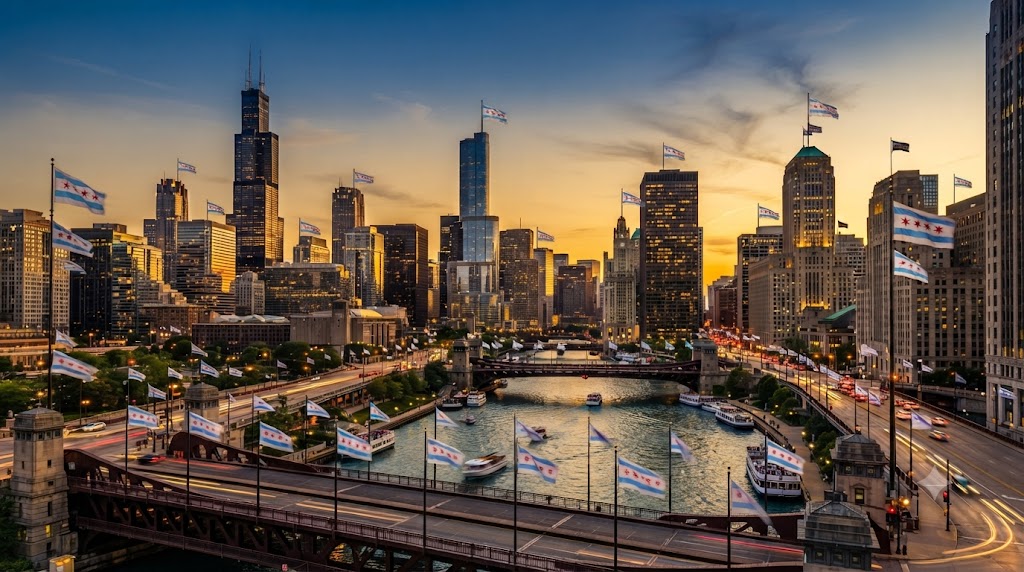
Designed by municipal scholar Wallace Rice, Chicago’s flag consists of two light blue horizontal stripes upon a white ground, charged with four sharp, six-pointed red stars. The flag is woven into the physical and emotional fabric of Chicago. When a Chicago police officer or firefighter falls in the line of duty, their casket is draped not in the American flag or Illinois state flag, but in the Chicago city flag. It is tattooed on citizens’ wrists and flies outside every neighborhood tavern.
The District of Columbia (Washington, D.C.)
Adopted in 1938, the flag of Washington, D.C. adapts the personal family coat of arms of General George Washington: a white field bearing two horizontal red bars surmounted by three red five-pointed stars (Argent, two bars Gules, in chief three mullets of the second). Striking, elegant, and completely devoid of text, it serves as an instantly recognizable emblem of the nation’s capital.
5. The Global Movement: From Europe to Australasia
The civic redesign movement is not confined to the United States. Across the globe, municipal authorities are updating historical standards for modern visual media:
- Amsterdam (Netherlands): Amsterdam’s flag—three white Saint Andrew’s crosses on a black vertical band flanked by red—is recognized as one of the most stylish urban flags in Europe, widely branded on city architecture, transport, and merchandise.
- Melbourne (Australia): Undergoing public debates to modernize its colonial coat of arms flag into a bold indigenous-inspired standard.
- Pocatello (Idaho, USA): Completely abolished its disastrous 2001 copyright banner in 2017, adopting a breathtaking geometric standard featuring mountain peaks, a compass star, and clean blue-and-gold palettes.
6. Frequently Asked Questions
Why do some traditionalists oppose flag redesigns?
Opposition to redesigns usually stems from historical nostalgia, fear of erasing heritage, or concerns that new designs look like “corporate tech logos.” Successful redesign committees overcome this by conducting deep historical research, ensuring that new minimalist flags preserve historic colors, founding dates, and sacred indigenous motifs rather than chasing transient corporate graphic fads.
Which US state is currently in the process of redesigning its flag?
States including Maine and Massachusetts have active legislative commissions. Maine held a public referendum in November 2024 regarding the return to its beloved 1901 original flag (a green pine tree and blue North Star on a buff field), demonstrating that the civic flag revolution is accelerating.
7. The Grassroots Miracle of Tulsa and Reno
The city of Tulsa, Oklahoma, represents the supreme modern case study in grassroots civic vexillography. Prior to 2017, Tulsa had no recognized municipal flag. A collective of passionate local citizens, designers, and business owners launched the Tulsa Flag Project completely independent of city government funding. They held public workshops, distributed design templates, and collected thousands of submissions.
The winning design—featuring an upper navy blue field, a lower red field, and a central horizontal gold stripe crossed by an Art Deco golden star and red circle—captured the city’s imagination overnight. Even before the city council officially adopted it, local shops printed the flag on coffee mugs, beer cans, skateboards, and murals. The council voted unanimously to ratify the flag in 2018, proving that when design is truly inspired, the public leads and the government follows.
8. Reno, Nevada: The Biggest Little Flag
In 2018, celebrating its sesquicentennial anniversary, Reno, Nevada, replaced its generic corporate logo banner with a breathtaking new design created by local resident Lily Baran. The flag depicts a deep blue sky above snow-capped Sierra Nevada mountains, a silver star honoring the “Silver State,” and a golden horizontal base representing the Truckee Meadows desert basin. The flag is celebrated by urbanists as a masterclass in modern municipal minimalism.
9. Economic and Tourism Dividends of Great Civic Flags
Urban economists increasingly recognize that great civic flags generate measurable economic value. In cities like Chicago, Washington D.C., and Amsterdam, the municipal flag is a multi-million-dollar merchandising asset. Tourists buy shirts, caps, and stickers bearing the city flag, while local businesses utilize the emblem to establish local authenticity and community goodwill. A great flag transforms a municipality from a mere administrative zone into a beloved cultural brand.
Global Vexillological Preservation: Institutional Archives, Legal Protections, and Heraldic Authorities
To preserve national standards and historic banners for future generations, sovereign nations maintain dedicated statutory bodies, heraldic colleges, and state archives. Studying how international institutions document, restore, and legally protect flag heritage reveals the profound cultural reverence accorded to vexillological artifacts worldwide.
A. The College of Arms and the Court of the Lord Lyon
In the United Kingdom and the Commonwealth, the granting and regulation of flags is administered by the College of Arms in London (established by King Richard III in 1484) and the Court of the Lord Lyon in Edinburgh, Scotland. In Scotland, the Lord Lyon King of Arms possesses judicial power under ancient acts of the Scottish Parliament: displaying an unauthorized or historically defective coat of arms or banner on a public building is a criminal offense, prosecutable in the Lyon Court.
B. The Flag Research Center and FIAV International Congresses
Founded in 1962 by Dr. Whitney Smith, the Flag Research Center pioneered the scientific methodology of modern vexillology. Together with the Fédération Internationale des Associations Vexillologiques (FIAV), uniting over fifty regional associations across six continents, scholars convene biennially at the International Congress of Vexillology (ICV) to debate historical flag discoveries, coordinate flag conservation science, and standardize digital vexillological taxonomy.
C. Constitutional Flag Protection Laws and Degradation Etiquette
National flag codes around the world mandate specific dignified procedures for retiring soiled or damaged standards. In the United States (4 U.S.C. § 8k), when a flag is no longer a fitting emblem for display, it should be destroyed in a dignified manner, preferably by burning during a respectful solemn ceremony. Similarly, the Flag Code of India (2002) mandates that damaged national flags must be destroyed privately in their entirety, preferably by burning or burying in accordance with sovereign dignity.
- Always hoist the national flag briskly to the peak and lower it ceremoniously with slow deliberation.
- Never allow a sovereign flag to touch the ground, floor, water, or objects beneath it.
- When flown alongside regional or corporate banners, the sovereign national flag always occupies the supreme position of honor.
- Never display a national flag upside down, except as a signal of dire medical or navigational distress.
- During half-mast mourning, first hoist the flag to the peak for an instant before lowering to half-staff.
- Illumination is required if a flag is displayed outdoors during the hours of darkness.
- Do not place advertising slogans, signatures, or unauthorized badges directly upon the field of a national standard.
- Store flags folded neatly in clean, moisture-free cases to prevent mold, fabric oxidation, and pest damage.
- When multiple foreign flags fly together, each must fly on its own staff of equal height and identical scale.
- Retire worn, faded, or frayed flags privately with dignity and reverence.