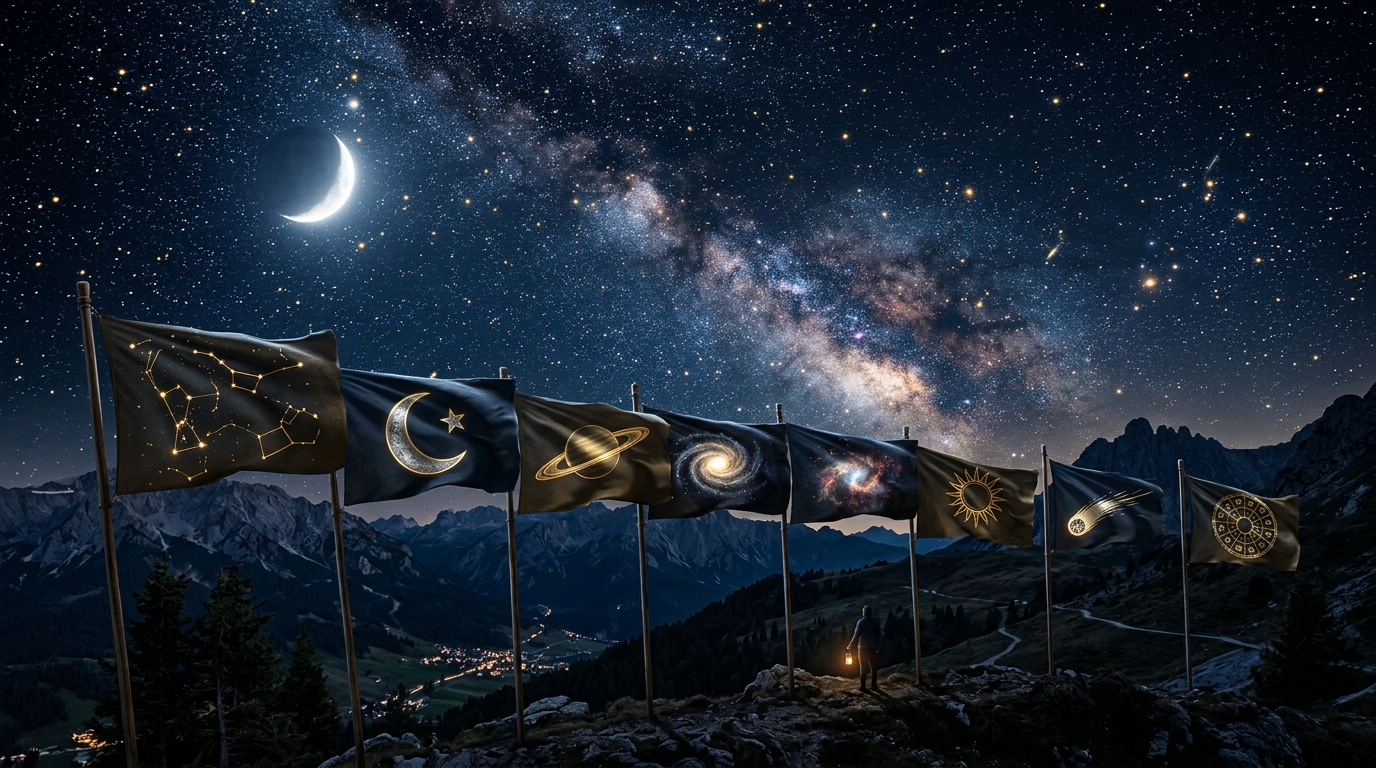
1. The Primordial Allure of the Heavens in Flag Design
Since the dawn of human civilization, humanity has cast its gaze toward the celestial vault to divine destiny, navigate open oceans, and conceptualize the divine. In vexillology, the heavens provide an infinite lexicon of universal symbols. Over sixty percent of the world’s sovereign national flags incorporate at least one celestial charge—whether a blazing solar disc, a waxing or waning lunar crescent, a singular radiant star, or a complex constellation of stellar bodies.
Why do celestial emblems exercise such total dominance in sovereign heraldry? Beyond their aesthetic elegance, celestial bodies transcend earthly imperfections. Unlike human portraits, dynastic crowns, or weapons of war—which are inherently transient and culturally parochial—the sun, moon, and stars are eternal, omnipotent, and universally recognized across all languages and epochs. A star or solar disc immediately projects cosmic authority, moral illumination, guiding leadership, and celestial protection over a sovereign state.
2. The Solar Disc: Radiance, Divinity, and Rebirth
The sun is the ultimate source of physical life on earth, and its representation on flags spans multiple continents, carrying deeply rooted theological and philosophical meanings:
The Hinomaru: Japan’s Land of the Rising Sun
The national flag of Japan, the Nisshoki (popularly known as the Hinomaru or “Sun Disc”), represents the pinnacle of minimalist vexillological perfection. Consisting of a crimson-red circular disc centered upon a pure white field, it embodies the ancient Shinto belief that the Japanese Imperial dynasty descends directly from Amaterasu Omikami, the celestial Sun Goddess. Documented in military use by samurai clans since the 12th century, the Hinomaru was formally codified for naval and merchant shipping in 1870 and reaffirmed by the Law Regarding the National Flag and Anthem in 1999, which established the disc’s diameter as precisely three-fifths of the vertical hoist.
The Sun of May (El Sol de Mayo) in South America
In the Southern Hemisphere, the national flags of Argentina and Uruguay feature the radiant Sol de Mayo. Depicting a golden solar disc with an expressive human face surrounded by alternating straight and wavy rays, it commemorates the May Revolution of 1810 in Buenos Aires. Legend recounts that as the patriotic crowds gathered before the Cabildo demanding self-governance, heavy rain clouds parted, and a brilliant golden sun burst through the overcast sky, interpreted by the patriots as a divine omen of impending liberty. Heraldically, it also pays homage to Inti, the ancient Incan sun god worshipped across the Andean highlands.
3. The Geometry of the Star: Points, Meaning, and Mathematics
In vexillology, a star is rarely an arbitrary graphic accent; the number of points (vertices) engineered into a star carries profound constitutional, territorial, or spiritual significance:
Five-Pointed Stars (The Pentagram)
The five-pointed star is by far the most ubiquitous charge in global heraldry, utilized by the United States (50 stars), the People’s Republic of China (5 stars), Vietnam, Chile, Cuba, and the European Union (circle of 12 stars). Traditionally associated with human dignity, republican liberty, and sovereign unity, the five points in socialist and communist iconography represent the five fingers of the worker’s hand or the unity of five social classes (workers, peasants, soldiers, intellectuals, and merchants).
Seven-Pointed Stars (The Commonwealth Star and Jordan)
The Commonwealth Star (Star of Federation) on the Australian national flag features seven points: six points symbolize the six original federating states (New South Wales, Victoria, Queensland, South Australia, Western Australia, and Tasmania), while the seventh point represents the Northern Territory, Australian Capital Territory, and all external territories. On the flag of Jordan, the seven-pointed white star represents the seven verses of the Al-Fatiha (the opening surah of the Holy Quran), as well as the unity of the Arab peoples.
The Fourteen-Pointed Star of Malaysia (Bintang Persekutuan)
The national flag of Malaysia (the Jalur Gemilang) features a magnificent gold fourteen-pointed star. Thirteen points represent the thirteen member states of the Malaysian federation, while the fourteenth point represents the federal government and federal territories (Kuala Lumpur, Labuan, and Putrajaya), articulating sovereign equality across the Malaysian peninsula and northern Borneo.
Adopted in 1979, the national flag of the Marshall Islands features an extraordinary white star with 24 points radiating upon a deep ocean blue field. The 24 rays represent the 24 electoral municipalities of the archipelago, while the four elongated primary rays point toward the cardinal directions in the shape of a navigational cross.
4. The Lunar Crescent: Nocturnal Illumination and Islamic Identity
The lunar crescent (frequently paired with one or more stars) is one of the most ancient motifs in human history. While modern observers associate it universally with the Islamic world, its heraldic application predates Islam by millennia, appearing on ancient Sumerian cylinder seals dedicated to Sin (the moon god), Carthaginian stelae, and Roman imperial coins.
In Islamic theological and cultural contexts, the new crescent moon (Hilal) governs the lunar Islamic Hijri calendar, determining the commencement of the holy month of Ramadan, Eid al-Fitr, and the Hajj pilgrimage. When the Ottoman Empire integrated the star and crescent into its administrative banners in the 18th and 19th centuries, it cemented the motif as the international visual ambassador of the Islamic world.
Orientation Nuances in Crescent Design
The angle at which the crescent horns point conveys distinct symbolic messages:
- Upward-Facing Crescent: The national flag of Mauritania features a crescent moon whose horns point upward like a cup, representing openness to divine blessings and heavenly grace.
- Forward-Facing (Rightward): The flags of Turkey, Pakistan, and Azerbaijan orient the crescent facing toward the fly, symbolizing dynamic forward momentum, progress, and enlightenment.
- Singapore’s Crescent and Five Stars: In Singapore’s flag, the crescent does not represent Islam; rather, it signifies “a young nation on the ascendant”, while the five encircling stars represent democracy, peace, progress, justice, and equality.
5. The Southern Cross: Navigating the Austral Skies
In the Southern Hemisphere, polar navigation was historically impossible using the North Star (Polaris). Instead, Polynesian voyagers and European mariners navigated by the Southern Cross (Crux)—the smallest yet most luminous constellation in the night sky. Today, the Southern Cross constitutes the unifying vexillological emblem of the Southern Oceans, appearing on the sovereign flags of five nations:
6. Brazil’s Astronomical Masterpiece: The Sky of November 15, 1889
The national flag of Brazil (the Auriverde) contains the most scientifically complex astronomical chart ever placed upon a sovereign banner. Inside the central blue celestial globe, crossed by a white curved band inscribed with the positivist motto “Ordem e Progresso” (“Order and Progress”), are 27 stars representing the 26 Brazilian states and the Federal District.
These stars are not arranged decoratively; they represent the exact positions of nine distinct constellations as viewed from Rio de Janeiro at 8:30 AM on November 15, 1889—the historic moment when the Republic of Brazil was proclaimed and Emperor Dom Pedro II was deposed. Furthermore, the stars are rendered as an observer standing outside the celestial sphere would view them (a mirror-reversed celestial globe view), representing the cosmos as seen from the heavens looking down upon Brazil.
7. Frequently Asked Questions
Why does the flag of the United States add stars when new states join?
Under the Third Flag Act passed by the US Congress in 1818, the number of stripes was fixed permanently at 13 (honoring the original revolutionary colonies), while a new star is legally added to the blue union on the 4th of July following the formal admission of any new state into the Union. The flag has evolved from 13 stars to 50 stars across 27 distinct official iterations.
What is the meaning of the 24-spoke Ashoka Chakra on India’s flag?
While not a celestial star in the Western sense, the Ashoka Chakra is a solar and dharmic cosmic wheel. Its 24 spokes represent the 24 hours of the day, continuous moral progress, self-realization, and the 24 universal ethical virtues taught in Buddhist and Vedic philosophy, symbolizing dynamic motion and righteous governance.
8. The Great Venezuelan Star Controversy: The Eighth Star
The number of stars on a national flag can ignite profound constitutional and diplomatic debates. The national flag of Venezuela features a horizontal tricolor of yellow, blue, and red with an arc of white stars in the central blue band. Originally, the flag bore seven stars, commemorating the seven original provinces that signed the 1811 Declaration of Independence.
However, in 1817, revolutionary hero Simón Bolívar issued an official decree ordering an eighth star to be added to represent the newly liberated province of Guayana (a vast mineral-rich region including the Orinoco river basin). Bolívar’s decree was neglected for nearly two centuries until March 2006, when President Hugo Chávez formally amended the National Flag Law to add the eighth star, honoring Bolívar’s original historical decree. The change sparked intense debate between government supporters and political opposition groups over the politicization of national heraldry.
The Big Dipper on the Alaskan Flag (Designed by a 13-Year-Old)
In 1927, the US territory of Alaska held a territorial flag contest. The winning submission was created by John Bell (Benny) Benson Jr., a thirteen-year-old indigenous Aleut boy residing at an orphanage in Seward. Benson’s design featured a deep blue field (representing the Alaskan sky and the forget-me-not flower) charged with eight golden stars:
- Seven stars form the Big Dipper (Ursa Major), the universal constellation of strength and the Great Bear.
- The eighth, larger star is the North Star (Polaris), symbolizing Alaska’s geographic position as the northernmost frontier of the United States.
Global Vexillological Preservation: Institutional Archives, Legal Protections, and Heraldic Authorities
To preserve national standards and historic banners for future generations, sovereign nations maintain dedicated statutory bodies, heraldic colleges, and state archives. Studying how international institutions document, restore, and legally protect flag heritage reveals the profound cultural reverence accorded to vexillological artifacts worldwide.
A. The College of Arms and the Court of the Lord Lyon
In the United Kingdom and the Commonwealth, the granting and regulation of flags is administered by the College of Arms in London (established by King Richard III in 1484) and the Court of the Lord Lyon in Edinburgh, Scotland. In Scotland, the Lord Lyon King of Arms possesses judicial power under ancient acts of the Scottish Parliament: displaying an unauthorized or historically defective coat of arms or banner on a public building is a criminal offense, prosecutable in the Lyon Court.
B. The Flag Research Center and FIAV International Congresses
Founded in 1962 by Dr. Whitney Smith, the Flag Research Center pioneered the scientific methodology of modern vexillology. Together with the Fédération Internationale des Associations Vexillologiques (FIAV), uniting over fifty regional associations across six continents, scholars convene biennially at the International Congress of Vexillology (ICV) to debate historical flag discoveries, coordinate flag conservation science, and standardize digital vexillological taxonomy.
C. Constitutional Flag Protection Laws and Degradation Etiquette
National flag codes around the world mandate specific dignified procedures for retiring soiled or damaged standards. In the United States (4 U.S.C. § 8k), when a flag is no longer a fitting emblem for display, it should be destroyed in a dignified manner, preferably by burning during a respectful solemn ceremony. Similarly, the Flag Code of India (2002) mandates that damaged national flags must be destroyed privately in their entirety, preferably by burning or burying in accordance with sovereign dignity.
- Always hoist the national flag briskly to the peak and lower it ceremoniously with slow deliberation.
- Never allow a sovereign flag to touch the ground, floor, water, or objects beneath it.
- When flown alongside regional or corporate banners, the sovereign national flag always occupies the supreme position of honor.
- Never display a national flag upside down, except as a signal of dire medical or navigational distress.
- During half-mast mourning, first hoist the flag to the peak for an instant before lowering to half-staff.
- Illumination is required if a flag is displayed outdoors during the hours of darkness.
- Do not place advertising slogans, signatures, or unauthorized badges directly upon the field of a national standard.
- Store flags folded neatly in clean, moisture-free cases to prevent mold, fabric oxidation, and pest damage.
- When multiple foreign flags fly together, each must fly on its own staff of equal height and identical scale.
- Retire worn, faded, or frayed flags privately with dignity and reverence.