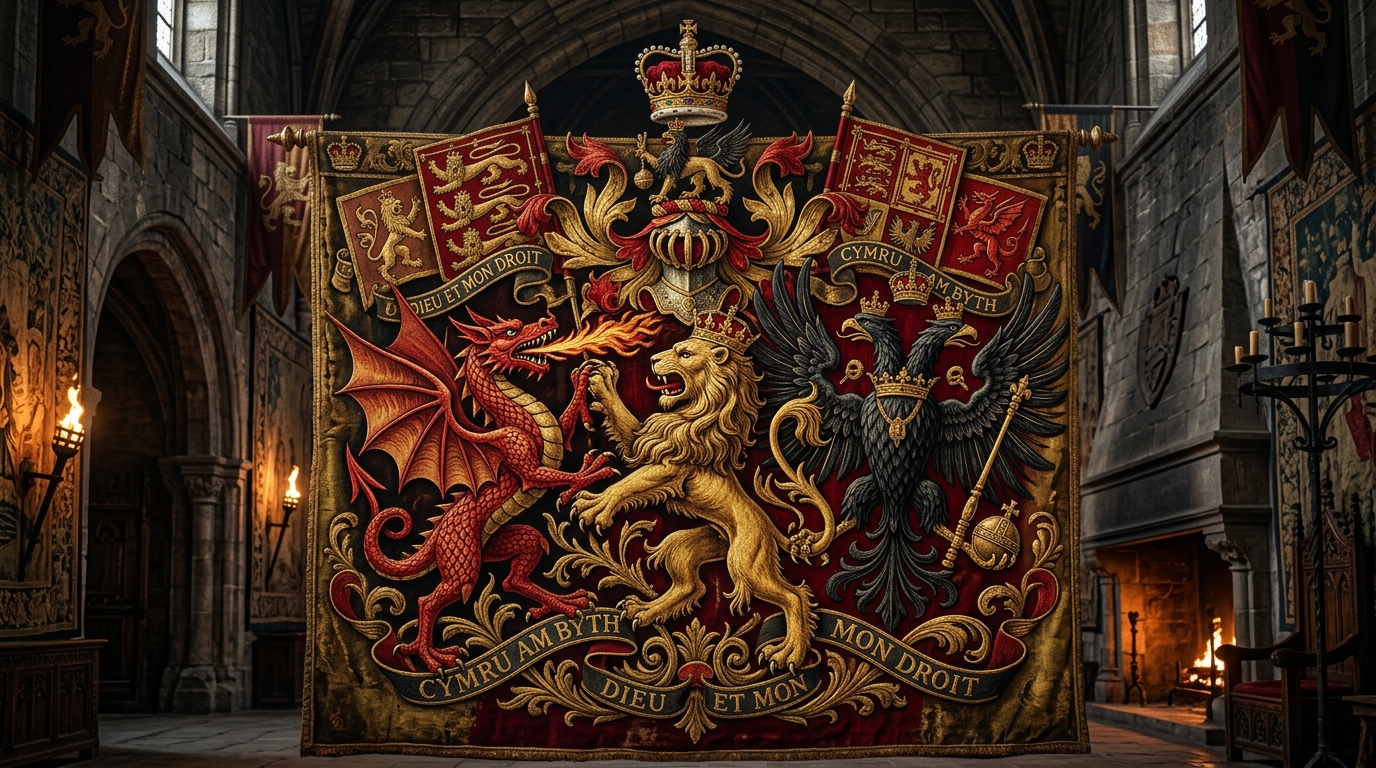
1. The Animal Kingdom in Sovereign Iconography
Throughout human history, sovereign rulers, warrior chieftains, and modern constitutional states have looked to the animal kingdom to project martial courage, imperial dominance, and territorial vigilance. On national flags and state heraldic coats of arms, animals are never selected at random; they are chosen because they occupy the pinnacle of their respective ecological food chains or embody mythic, supernatural virtues capable of striking awe into allies and adversaries alike.
In heraldic tradition, beasts are subjected to rigorous stylization. They are depicted with bared claws, flared tongues, and exaggerated musculature to emphasize raw combat vitality. Over centuries, three apex creatures emerged as the absolute sovereigns of global vexillology: the Lion (King of Beasts), the Eagle (Monarch of the Air), and the Dragon (The Primordial Mythic Guardian).
2. The Lion: The Undisputed Monarch of Heraldry
The lion is the most frequently depicted animal in global heraldry, appearing on dozens of national coats of arms across Europe, Africa, and Asia. In medieval European heraldry, the lion was the supreme symbol of royalty, chivalric honor, and Christian kingship, immortalized by monarchs such as Richard the Lionheart of England.
The Lion Rampant of Sri Lanka (The Golden Sinhalaya)
The national flag of Sri Lanka features one of the most magnificent beast charges in world vexillology: a golden lion holding an upright sword of state (the Kastane) in its right forepaw upon a rich maroon field. Known as the Sinha Flag, its history stretches back over 2,500 years to Prince Vijaya, the legendary founder of the Sinhalese people (Sinhala literally translating to “Lion People”). The sword represents the sovereignty of the nation, while the four leaves of the sacred Bo tree in the corners represent the Buddhist virtues of Metta (loving-kindness), Karuna (compassion), Mudita (sympathetic joy), and Upekkha (equanimity).
The Golden Lion of Belgium, Norway, and the Netherlands
Across Northern and Western Europe, the lion rampant dominates state heraldry. The national coat of arms of Norway features a golden crowned lion rampant grasping the silver battle-ax of Saint Olaf upon a red shield, an emblem utilized continuously since 1280. Similarly, the Kingdom of the Netherlands and the Kingdom of Belgium utilize the ancient lion of the House of Nassau and the Duchy of Brabant, symbolizing fearless defiance against foreign conquerors.
3. The Eagle: Apex Lord of the Skies
If the lion commands the earth, the eagle rules the air. Associated with the ancient Greek god Zeus and Roman Jupiter, the eagle was revered for its unmatched eyesight, high-altitude flight, and devastating diving speed. In modern vexillology, the eagle appears in three major manifestations:
The Bundesadler of Germany
The German Bundesadler (Federal Eagle) is one of the oldest state emblems in Europe, descending directly from the imperial eagle standard of Charlemagne and the Holy Roman Empire. Today, rendered in a bold, modern geometric form on the German state flag (Bundesdienstflagge), the black eagle with red beak and claws on a golden field represents the strength and permanence of German constitutional democracy.
The White Eagle of Poland (Orzel Bialy)
According to Polish founding mythology, the tribal chieftain Lech was searching for a homeland when he beheld a magnificent white eagle nesting atop a tree against a crimson sunset. Taking this as a divine omen, he founded the city of Gniezno and adopted the white eagle as his standard. Surviving centuries of foreign partition under Prussian, Austrian, and Russian empires, the crowned White Eagle remains the sacred heraldic heartbeat of the Polish nation.
The Mexican Golden Eagle and Rattlesnake
The central emblem of the Mexican national flag illustrates one of the most dramatic predator scenes in all of heraldry: a Mexican golden eagle perched upon a prickly pear cactus growing from a rock in a lake, fiercely gripping and devouring a rattlesnake. According to Aztec codices, the sun god Huitzilopochtli commanded the wandering Mexica nomads to build their capital city where they witnessed this exact scene. In 1325, they discovered the eagle on Lake Texcoco and founded Tenochtitlan (modern-day Mexico City), an indigenous founding myth enshrined forever on Mexico’s sovereign standard.
In classical heraldic language:
– Rampant: Rearing up on the left hind foot with paws clawing forward.
– Passant: Walking forward on three legs with the right forepaw raised.
– Displayed: Rendered facing the viewer with wings expanded and tips pointed upward.
– Statant: Standing motionless on all four legs.
4. The Dragon: Mythic Sovereignty in Wales and Bhutan
Unlike lions and eagles, the dragon does not inhabit the biological world; yet its symbolic resonance on sovereign flags is unparalleled. Only two sovereign and regional entities feature dragons on their primary banners:
Y Ddraig Goch: The Red Dragon of Wales
The national flag of Wales features Y Ddraig Goch (The Red Dragon) passant upon a field divided horizontally into white and green (the heraldic livery colors of the Welsh House of Tudor). Documented in Celtic Arthurian legends and the 9th-century Historia Brittonum, the red dragon fought a mythic subterranean duel against a white dragon representing invading Anglo-Saxons. Merlin prophesied that the red dragon would ultimately triumph and reclaim Britain. Formally codified by royal warrant in 1959, the Welsh dragon stands as an unbroken symbol of indigenous Celtic survival.
Druk: The Thunder Dragon of Bhutan
The Himalayan Kingdom of Bhutan is known natively as Druk Yul (“Land of the Thunder Dragon”). Bhutan’s flag is divided diagonally from the lower hoist to the upper fly into yellow (representing the secular authority of the Druk Gyalpo king) and orange (representing the spiritual tradition of Drukpa Kagyu Buddhism). Splitting the two colors along the diagonal is Druk, a pure white dragon clutching dazzling jewels (norbu) in its claws.
The white color of the dragon represents purity, loyalty, and the diverse ethnic peoples of Bhutan. The snarling mouth symbolizes the terrifying thunderbolts that echo across Himalayan peaks, while the jewels in its talons represent the nation’s spiritual and material wealth and cosmic protection.
5. The Double-Headed Eagle: Imperial Dominion Over Two Worlds
While single eagles represent vigilance, the double-headed eagle represents absolute, universal empire. As explored in Byzantine history, this creature was adopted by the Holy Roman Empire, the Russian Empire, and the Austro-Hungarian Empire. Today, it remains the sovereign emblem of Albania, where a black double-headed eagle spreads its wings across a blood-red field.
Albania is known natively as Shqiperia (“Land of the Eagles”). The banner was raised in 1443 by national hero Gjergj Kastrioti (Skanderbeg) during his historic defense of Kruje castle against the Ottoman Empire. For Albanians, the eagle is not a foreign imperial import, but an indigenous totem of liberty and mountain independence.
6. Frequently Asked Questions
Why does the United States flag use stars instead of the Bald Eagle?
While the Bald Eagle is the supreme national emblem on the Great Seal of the United States and the Presidential Standard, the national flag of the US was intentionally designed around democratic stars and stripes rather than animal heraldry. The founders sought a visual break from European monarchical traditions, which relied heavily on royal predatory beasts.
Which African flags feature birds or beasts?
Numerous African nations incorporate indigenous wildlife: Uganda features the regal Grey Crowned Crane on a central white disc; Zimbabwe displays the sacred soapstone Zimbabwe Bird; and Eswatini portrays an indigenous ox-hide battle shield flanked by bird feather plumes.
8. The Steppe Eagle of Kazakhstan and the Lion of Saint Mark
Beyond lions and dragons, the animal kingdom offers extraordinary regional heraldic expressions. The national flag of Kazakhstan, adopted in 1992 following the collapse of the Soviet Union, features a soaring golden Steppe Eagle (Berkut) gliding beneath a radiant 32-rayed sun upon an azure blue field. Designed by Shaken Niyazbekov, the eagle represents the freedom, power, and vast nomadic spirit of the Kazakh people, who have practiced traditional falconry on the Eurasian steppe for thousands of years.
The Winged Lion of Saint Mark (Republic of Venice)
For over a millennium, the maritime merchant Republic of Venice ruled the eastern Mediterranean under the banner of the Winged Lion of Saint Mark. Depicting a golden winged lion holding an open Bible inscribed with the Latin words “Pax tibi Marce, evangelista meus” (“Peace unto you, Mark, my evangelist”), the flag featured six elongated fringed tails representing the six historical sestieri (districts) of Venice. In times of war, the open Bible was replaced with a raised sword, signaling that the Serene Republic had taken up arms.
Global Vexillological Preservation: Institutional Archives, Legal Protections, and Heraldic Authorities
To preserve national standards and historic banners for future generations, sovereign nations maintain dedicated statutory bodies, heraldic colleges, and state archives. Studying how international institutions document, restore, and legally protect flag heritage reveals the profound cultural reverence accorded to vexillological artifacts worldwide.
A. The College of Arms and the Court of the Lord Lyon
In the United Kingdom and the Commonwealth, the granting and regulation of flags is administered by the College of Arms in London (established by King Richard III in 1484) and the Court of the Lord Lyon in Edinburgh, Scotland. In Scotland, the Lord Lyon King of Arms possesses judicial power under ancient acts of the Scottish Parliament: displaying an unauthorized or historically defective coat of arms or banner on a public building is a criminal offense, prosecutable in the Lyon Court.
B. The Flag Research Center and FIAV International Congresses
Founded in 1962 by Dr. Whitney Smith, the Flag Research Center pioneered the scientific methodology of modern vexillology. Together with the Fédération Internationale des Associations Vexillologiques (FIAV), uniting over fifty regional associations across six continents, scholars convene biennially at the International Congress of Vexillology (ICV) to debate historical flag discoveries, coordinate flag conservation science, and standardize digital vexillological taxonomy.
C. Constitutional Flag Protection Laws and Degradation Etiquette
National flag codes around the world mandate specific dignified procedures for retiring soiled or damaged standards. In the United States (4 U.S.C. § 8k), when a flag is no longer a fitting emblem for display, it should be destroyed in a dignified manner, preferably by burning during a respectful solemn ceremony. Similarly, the Flag Code of India (2002) mandates that damaged national flags must be destroyed privately in their entirety, preferably by burning or burying in accordance with sovereign dignity.
- Always hoist the national flag briskly to the peak and lower it ceremoniously with slow deliberation.
- Never allow a sovereign flag to touch the ground, floor, water, or objects beneath it.
- When flown alongside regional or corporate banners, the sovereign national flag always occupies the supreme position of honor.
- Never display a national flag upside down, except as a signal of dire medical or navigational distress.
- During half-mast mourning, first hoist the flag to the peak for an instant before lowering to half-staff.
- Illumination is required if a flag is displayed outdoors during the hours of darkness.
- Do not place advertising slogans, signatures, or unauthorized badges directly upon the field of a national standard.
- Store flags folded neatly in clean, moisture-free cases to prevent mold, fabric oxidation, and pest damage.
- When multiple foreign flags fly together, each must fly on its own staff of equal height and identical scale.
- Retire worn, faded, or frayed flags privately with dignity and reverence.