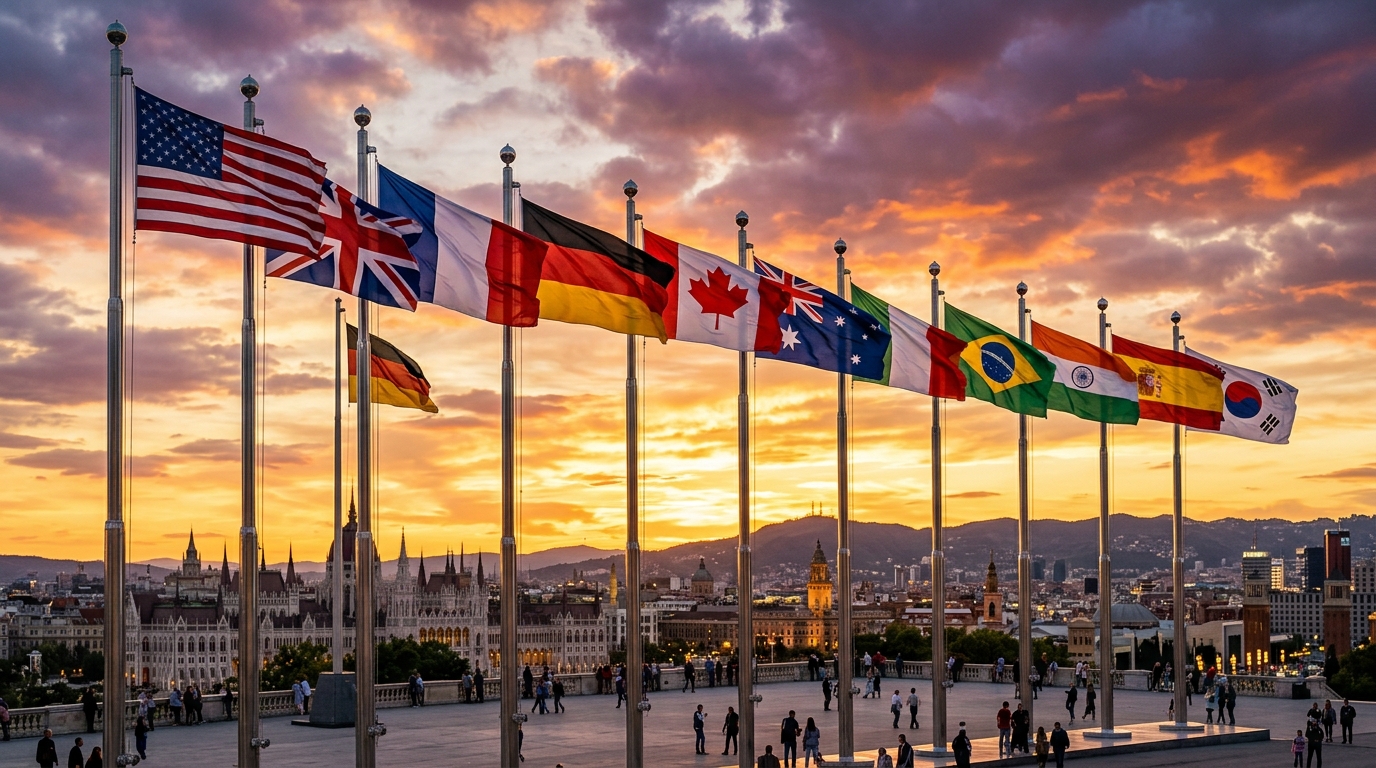
1. Introduction to Sovereign Flag Specifications
A national flag is the primary visual embodiment of a nation’s constitutional sovereignty, territorial integrity, and collective memory. While casually viewed as dyed fabric fluttering from a staff, sovereign flags are meticulously engineered heraldic artifacts governed by precise statutory acts, executive decrees, and international vexillological treaties. The design of each national standard requires specific dimensional constraints, heraldic color tolerances, and standardized mechanical proportions designed to ensure optical clarity across vast distances, in variable wind conditions, and on digital screens.
Historically, the codification of national flags began in naval contexts where instantaneous identification at sea was a life-or-death imperative. An ambiguous banner could invite cannon fire from an allied warship or conceal a hostile privateer. Consequently, maritime nations led the transition toward standardized dimensions, distinct field geometry, and unambiguous tint designations. In modern international diplomacy, bodies such as the United Nations protocol office enforce stringent standardization rules during multilateral summits, regulating vertical and horizontal dimensions to ensure that no sovereign nation appears diminished in relation to its peers.
2. The Mathematics of Aspect Ratios in National Flags
In vexillology, the proportions of a flag are consistently expressed as the ratio of its vertical height (the hoist) to its horizontal length (the fly). While the general public frequently assumes all flags share a uniform rectangular shape, sovereign nations employ a diverse spectrum of aspect ratios dictated by cultural tradition, naval heritage, and aesthetic philosophy.
The Dominance of 2:3 and 1:2 Dimensions
The two most widespread proportions in global vexillology are 2:3 and 1:2. The 2:3 ratio is utilized by over 85 sovereign entities, including France, Spain, Italy, Japan, and the Russian Federation. This proportion provides an ideal compromise between aerodynamic performance—allowing the fabric to unfurl cleanly in moderate breezes—and optical balance on flagpoles. Conversely, the 1:2 ratio has historic roots in the maritime traditions of the British Royal Navy and the British Empire, remaining standard today across the United Kingdom, Canada, Australia, New Zealand, and numerous Commonwealth jurisdictions.
Unique Mathematical Anomalies: Nepal and the United States
The national flag of Nepal represents the most mathematically complex sovereign banner in existence. Rather than a rectangle, it consists of two stacked pennons featuring a crescent moon and sun. Schedule 1 of the Constitution of Nepal provides a rigorous step-by-step geometric construction procedure utilizing compass and straightedge proofs across dozens of clauses to define every coordinate, line intersection, and angle with absolute trigonometric precision.
In contrast, the United States flag is built around a distinctive 10:19 ratio established formally under President Dwight D. Eisenhower in 1959. This specific ratio was engineered so that the blue canton occupying precisely 40% of the fly length and seven-thirteenths of the hoist height harmonizes with the alternate red and white stripes without creating visual crowding or excessive horizontal elongation.
3. Chromatic Standardization: From Heraldic Tinctures to Digital Color Spaces
For centuries, flags were described purely through heraldic tinctures: Gules (Red), Azure (Blue), Vert (Green), Sable (Black), Purpure (Purple), and the two metals Or (Gold/Yellow) and Argent (Silver/White). While this system provided symbolic consistency, it lacked industrial reproducibility. A weaver in London and a dyer in Paris might interpret Gules with dramatically different hues—from vermilion orange to deep crimson.
Modern Standardized Color Systems
In modern international manufacturing, national governments specify flag colors using exact proprietary and public color coordinates. The most widely referenced standards include:
- Pantone Matching System (PMS): The global benchmark for spot-color ink and textile dye formulations.
- CIELAB (L*a*b*): Device-independent color models that quantify human visual perception under standardized illumination (D65 standard daylight).
- RGB & Hexadecimal: Formulations essential for digital displays, government websites, and electronic broadcasting.
- CMYK: Subtractive four-color process specifications used for paper printing and publication literature.
In 2020, French President Emmanuel Macron quietly ordered the Elysee Palace to transition the blue of the French Tricolor from the lighter European Union Marian Blue (Pantone Reflex Blue) back to the historic darker Navy Blue (Pantone 282 C) adopted originally during the French Revolution in 1794. The shift honored revolutionary naval veterans and created a more solemn aesthetic against television backdrops.
4. Structural Anatomy and Construction Terminology
Understanding sovereign flag specifications requires mastery of standardized vexillological nomenclature. Every rectangular flag consists of distinct anatomical zones, each carrying structural and symbolic importance:
- Hoist: The side of the flag attached to the halyard or flagpole; also refers to the total vertical dimension of the flag.
- Fly: The free-floating horizontal edge extending outward from the pole; also designates the total horizontal width.
- Canton: The upper hoist quarter (top-left) of the flag, historically reserved for devices of sovereign authority such as the Union Flag, stars, or religious crosses.
- Field or Ground: The primary background canvas upon which emblems, charges, or dividing stripes are placed.
- Charge: Any heraldic symbol, emblem, animal, or star placed upon the field of the flag.
- Fimbriation: A narrow border of contrasting color (frequently white or gold) separating two adjacent colors to satisfy heraldic visibility rules and prevent visual bleed.
The Critical Role of Fimbriation
Fimbriation is brilliantly demonstrated in the national flag of South Africa, adopted in 1994. The central green ‘Y’ shaped pall is separated from the red and blue horizontal fields by white fimbriations, and from the black hoist chevron by yellow fimbriations. Without these precise narrow dividing strips, the black and green would visually merge into an undifferentiated dark mass when observed from distances greater than 200 meters.
5. Typologies of Sovereign Flags: Civil, State, and War Standards
Many sovereign states do not possess a single universal flag, but rather a triad of distinct variations codified under international vexillological classification systems created by Dr. Whitney Smith:
6. Protocol, Etiquette, and Diplomatic Flag Laws
The display of national flags is regulated by strict diplomatic customs. When multiple sovereign flags are hoisted alongside one another in an international assembly, every flag must be flown on its own individual staff of equal height, and all flags must be manufactured to comparable surface areas. Hoisting one sovereign nation’s flag physically above another on the same halyard is considered a severe diplomatic insult symbolizing military conquest or colonial subjugation.
During national mourning, the flag is flown at half-mast (or half-staff). The international protocol dictates that the flag must first be hoisted briskly to the pinnacle of the staff for an instant, then lowered slowly to the half-mast position (traditionally the width of one flag down from the top). Before being retired at sunset, it must once again be raised to the peak before being lowered completely.
The national flags of Saudi Arabia, Iran, and Somaliland are never flown at half-mast under any circumstances. Because these banners feature sacred Islamic calligraphy (such as the Shahada or Takbir), lowering the flag is considered blasphemous under their respective constitutional laws.
7. Frequently Asked Questions Regarding National Flag Specifications
Why are the flags of Switzerland and Vatican City square?
The Swiss national flag traces its origin to medieval canton war banners carried by confederate infantry regiments in the 14th century, which were uniformly square for mobility in close-formation pikemen combat. When the modern Swiss constitution was formalized, the square ratio (1:1) was preserved for land use, although a rectangular 2:3 version is legally authorized for Swiss commercial shipping on international waterways. Vatican City adopted the square standard following the 1929 Lateran Treaty, reflecting historic papal military standards.
Which national flag features the highest number of distinct colors?
The national flag of Belize, adopted upon independence in 1981, features twelve distinct colors within its elaborate central coat of arms, making it the most multi-hued sovereign flag in the world. The emblem portrays two woodcutters of different ethnicities standing beneath a mahogany tree, holding tools of forestry surrounded by a floral laurel wreath.
How are sovereign flags displayed when flown vertically?
When a national flag is hung vertically (such as from a balcony or stadium rafter), simply rotating the flag 90 degrees clockwise is frequently incorrect. For example, on the United States flag, the blue canton must always remain in the observer’s top-left corner, meaning the flag must be rotated and reversed. Similarly, Germany and Slovakia maintain specifically manufactured vertical banners (Knatterflaggen) where coats of arms and stripes are rearranged to preserve proper heraldic orientation.
8. International Diplomatic Precedence: UN and Olympic Protocols
In multilateral diplomatic summits and international sporting events, the arrangement and display of sovereign national flags is governed by rigid international treaties designed to prevent diplomatic incidents. When sovereign states assemble at the United Nations General Assembly, flags are arranged in strict alphabetical order according to the English language names of the member states, commencing with Afghanistan on the far left and concluding with Zimbabwe on the far right.
At the Olympic Games, a unique diplomatic exception is granted by the International Olympic Committee (IOC) charter: the national flag of Greece always leads the Parade of Nations, honoring Greece as the ancient birthplace of the Olympic movement, while the host nation’s flag enters last. All other participating national delegations march in the alphabetical order of the host nation’s native language.
The ISO 3166-1 Standard for Sovereign Territory
In international trade, aviation, and digital systems, sovereign flags are tied to the ISO 3166-1 standard maintained by the International Organization for Standardization. This system assigns two-letter alpha-2 codes (e.g., FR for France, JP for Japan, IN for India) and three-letter alpha-3 codes (e.g., FRA, JPN, IND) that serve as universal digital keys for displaying emoji flags on mobile operating systems and managing maritime vessel registries.
Global Vexillological Preservation: Institutional Archives, Legal Protections, and Heraldic Authorities
To preserve national standards and historic banners for future generations, sovereign nations maintain dedicated statutory bodies, heraldic colleges, and state archives. Studying how international institutions document, restore, and legally protect flag heritage reveals the profound cultural reverence accorded to vexillological artifacts worldwide.
A. The College of Arms and the Court of the Lord Lyon
In the United Kingdom and the Commonwealth, the granting and regulation of flags is administered by the College of Arms in London (established by King Richard III in 1484) and the Court of the Lord Lyon in Edinburgh, Scotland. In Scotland, the Lord Lyon King of Arms possesses judicial power under ancient acts of the Scottish Parliament: displaying an unauthorized or historically defective coat of arms or banner on a public building is a criminal offense, prosecutable in the Lyon Court.
B. The Flag Research Center and FIAV International Congresses
Founded in 1962 by Dr. Whitney Smith, the Flag Research Center pioneered the scientific methodology of modern vexillology. Together with the Fédération Internationale des Associations Vexillologiques (FIAV), uniting over fifty regional associations across six continents, scholars convene biennially at the International Congress of Vexillology (ICV) to debate historical flag discoveries, coordinate flag conservation science, and standardize digital vexillological taxonomy.
C. Constitutional Flag Protection Laws and Degradation Etiquette
National flag codes around the world mandate specific dignified procedures for retiring soiled or damaged standards. In the United States (4 U.S.C. § 8k), when a flag is no longer a fitting emblem for display, it should be destroyed in a dignified manner, preferably by burning during a respectful solemn ceremony. Similarly, the Flag Code of India (2002) mandates that damaged national flags must be destroyed privately in their entirety, preferably by burning or burying in accordance with sovereign dignity.
- Always hoist the national flag briskly to the peak and lower it ceremoniously with slow deliberation.
- Never allow a sovereign flag to touch the ground, floor, water, or objects beneath it.
- When flown alongside regional or corporate banners, the sovereign national flag always occupies the supreme position of honor.
- Never display a national flag upside down, except as a signal of dire medical or navigational distress.
- During half-mast mourning, first hoist the flag to the peak for an instant before lowering to half-staff.
- Illumination is required if a flag is displayed outdoors during the hours of darkness.
- Do not place advertising slogans, signatures, or unauthorized badges directly upon the field of a national standard.
- Store flags folded neatly in clean, moisture-free cases to prevent mold, fabric oxidation, and pest damage.
- When multiple foreign flags fly together, each must fly on its own staff of equal height and identical scale.
- Retire worn, faded, or frayed flags privately with dignity and reverence.