1. The Greatest Geopolitical Metamorphosis in Human History
In 1945, at the conclusion of World War II, the United Nations was founded with just 51 original member states. Immense European colonial empires—principally the British, French, Belgian, Dutch, and Portuguese—held hundreds of millions of people across Africa, Asia, and the Pacific in colonial subjugation. Over the next four decades, an unprecedented historical earthquake swept the planet: the Great Wave of Decolonization.
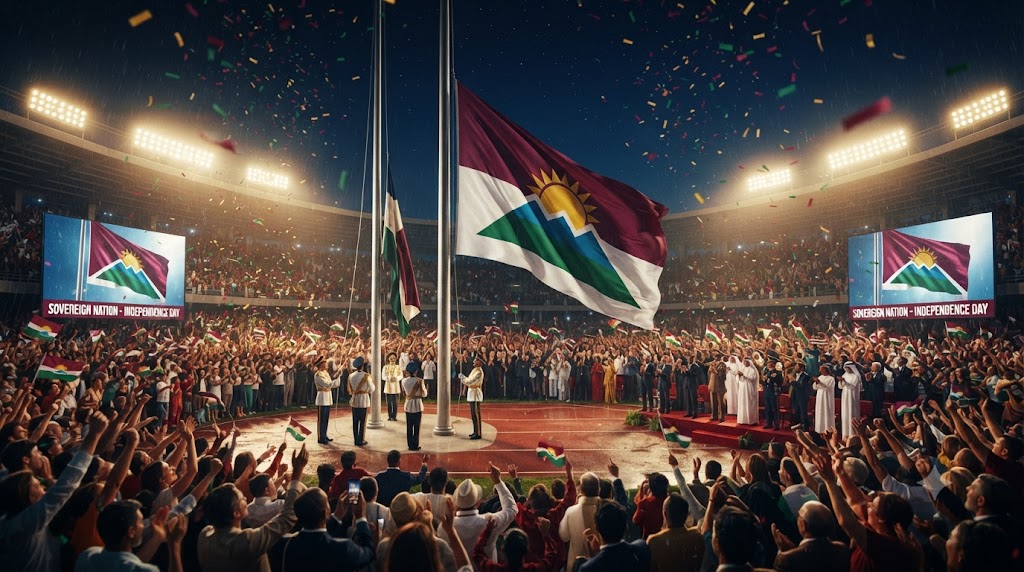
Between 1947 and 1980, more than one hundred newly independent nations declared their sovereign existence, fundamentally transforming the map of the globe. At the heart of every independence ceremony—from New Delhi and Accra to Kingston, Port Moresby, and Harare—was a solemn, electrifying visual ritual: The Lowering of the Colonial Flag and the Hoisting of the New National Standard. In that singular instant, as the Union Jack or French tricolor slid down the staff and the new national colors ascended into the midnight sky, centuries of colonial subjugation ended, and sovereign statehood began.
2. The Midnight Hour: India and Pakistan (August 1947)
The first monumental rupture of the post-war colonial order occurred on the Indian subcontinent at midnight on August 14–15, 1947. Emerging from the British Raj, two sovereign nations hoisted their new standards:
The Indian Tiranga: Saffron, White, Green, and the Ashoka Chakra
Designed in its original form by freedom fighter Pingali Venkayya and adopted by the Constituent Assembly on July 22, 1947, the Tiranga (Tricolor) replaced Mahatma Gandhi’s traditional hand-spinning wheel (charkha) with the sacred Ashoka Chakra—the 24-spoke wheel of law carved into the 3rd-century BC Lion Capital of Emperor Ashoka at Sarnath.
Philosopher and Vice-President Dr. Sarvepalli Radhakrishnan masterfully articulated the flag’s universal spiritual values to the nation:
“Bhagwa or saffron denotes renunciation and disinterestedness. Our leaders must be indifferent to material gains and dedicate themselves to work. The white in the center is light, the path of truth to guide our conduct. The green shows our relation to the soil, our relation to the plant life here upon which all other life depends. The Ashoka Wheel is the wheel of the law of dharma. Truth and virtue ought to be the controlling principles of all who work under this flag.”
3. The African Independence Explosion (1957–1968)
Nowhere was the flag creation explosion more dramatic than across the African continent. In the single landmark year of 1960—known to global history as the “Year of Africa”—seventeen African nations achieved independence from French, British, and Italian colonial control, hoisting seventeen vibrant new sovereign banners in a span of twelve months.
Led by Ghana in 1957, African nations repudiated the heraldic symbols of European aristocracy. Instead, they forged a new visual language rooted in:
- Ancestral Bloodshed: Red horizontal and vertical bands honoring the sacrifices of anti-colonial freedom fighters.
- Agricultural Bounty: Vibrant greens representing rich rainforests, savannahs, and agricultural harvests.
- Solar and Mineral Wealth: Golden yellows celebrating Africa’s immense underground reserves of gold, copper, and diamonds.
- Indigenous Identity: Bold black fields and stars asserting African pride and sovereignty.
In 1971, as Papua New Guinea prepared for independence from Australia, a nationwide design contest produced several complex proposals. Fifteen-year-old indigenous schoolgirl Susan Karike submitted a bold, hand-drawn sketch dividing the flag diagonally into red and black: the upper red half featuring the magnificent indigenous Kumul (Bird of Paradise) and the lower black half bearing the Southern Cross constellation. Her design was adopted unanimously by parliament, demonstrating that the greatest flags are born from the heart of everyday citizens.
4. Caribbean Sovereignty: Breaking Free from the Sugar Empire
In the Caribbean basin, the 1960s witnessed the peaceful dissolution of the British West Indies. Nations like Jamaica, Trinidad and Tobago, and Barbados created flags that rejected traditional European tricolors in favor of audacious graphic innovations:
Trinidad and Tobago’s Dynamic Diagonal (1962)
Designed by Carlisle Chang, the flag of Trinidad and Tobago broke all colonial conventions: a fiery red field traversed from upper hoist to lower fly by a bold black diagonal stripe bordered by white fimbriations. The black represents the strength, resilience, and petroleum wealth of the people; red represents the vitality of the sun and courageous struggle; and white represents the surrounding Caribbean sea and purity of aspirations.
The Broken Trident of Barbados (1966)
Under the British colonial badge, the seal of Barbados depicted the Roman sea god Neptune holding an intact trident. When Barbados achieved sovereignty under Prime Minister Errol Barrow in 1966, graphic designer Grantley Prescod created a brilliant symbolic coup: a gold vertical band flanked by ultramarine blue, charged with a Broken Trident. The broken shaft symbolized Barbados’s historic break from colonial servitude, while the three prongs represented the democratic principles of government of, for, and by the people.
5. The Final Chapter: South Africa and the Rainbow Nation (1994)
The culmination of the 20th-century decolonization struggle took place in South Africa with the dismantling of the apartheid regime and the democratic election of President Nelson Mandela in April 1994. The old apartheid standard—the Oranje, Blanje, Blou featuring miniature colonial flags—was a hated symbol of racial oppression.
State Herald Frederick Brownell was tasked with designing a temporary transitional flag in a matter of weeks. His design—the six-colored horizontal ‘Y’ shape (pall)—brilliantly integrated the colors of the liberation struggle (black, green, gold of the ANC) with the historic colors of the British and Afrikaner communities (red, white, blue). The flag captured the imagination of the nation so deeply during the 1994 elections and the 1995 Rugby World Cup that the interim design was permanently confirmed in the final South African Constitution, standing as the supreme visual monument to the triumph of human reconciliation over racial segregation.
6. Frequently Asked Questions
Why did some post-colonial nations retain the British Union Jack?
Nations like Australia, New Zealand, Tuvalu, and Fiji retained the Union Jack in their cantons primarily because their transitions to sovereignty were gradual constitutional evolutions within the British Commonwealth rather than violent armed revolutions, preserving historic constitutional, legal, and monarchical ties to the British Crown.
Which African nation was the last to achieve independence in the 20th century?
Namibia achieved formal sovereign independence in March 1990, freeing itself from South African mandate administration. Its brilliant flag features blue, green, red, white, and a radiant 12-rayed golden sun, symbolizing peace, mineral wealth, and the eternal vitality of the Namibian people.
7. The Algerian War of Independence and the Star & Crescent
One of the most protracted, heroic anti-colonial wars of the 20th century was the Algerian War of Independence (1954–1962) fought by the National Liberation Front (FLN) against French colonial rule. The flag of free Algeria was conceived in the 1920s by nationalist leader Messali Hadj, synthesizing Islamic identity with revolutionary courage.
The flag is divided vertically into two equal halves of pure green (symbolizing Islam, nature, and fertile Algerian soil) and pure white (symbolizing purity, peace, and national innocence). Centered across the dividing line is a vibrant red star and crescent, with red representing the blood shed by over one million Algerian martyrs in the struggle for liberty. When Algeria proclaimed independence in July 1962, this banner was hoisted across Algiers, cementing its place as a sacred symbol of anti-colonial victory.
8. The Evolution of the Congolese Flag: From Lumumba to Kabila
The Democratic Republic of the Congo (formerly Zaire) experienced one of the most turbulent vexillological evolutions in post-colonial history. In 1960, under Prime Minister Patrice Lumumba, the nation adopted a sky blue flag bearing six small golden stars along the hoist and a large central golden star, adapted from the old colonial Association Internationale du Congo flag.
In 1971, dictator Mobutu Sese Seko renamed the country Zaire and instituted the radical “Authenticity” policy, replacing the blue flag with a green banner featuring a yellow circle holding a black hand bearing a flaming torch of revolution. Following the fall of Mobutu in 1997 and the adoption of the 2006 Constitution, the DRC adopted its current masterpiece: a sky blue field crossed by a red diagonal stripe with yellow fimbriation, accompanied by a golden star in the canton. Sky blue represents peace, red the blood of martyrs, yellow the nation’s mineral wealth, and the star a radiant future.
9. The Triumphant Legacy of 20th-Century Vexillological Liberation
The great wave of decolonization proved that the desire for self-determination is universal. Across four continents, indigenous peoples tore down the heraldry of foreign empires and hoisted banners that reflected their authentic traditions, sacred soil, and unyielding dreams for the future. These flags stand today at the United Nations as eternal witnesses to the victory of human freedom.
Global Vexillological Preservation: Institutional Archives, Legal Protections, and Heraldic Authorities
To preserve national standards and historic banners for future generations, sovereign nations maintain dedicated statutory bodies, heraldic colleges, and state archives. Studying how international institutions document, restore, and legally protect flag heritage reveals the profound cultural reverence accorded to vexillological artifacts worldwide.
A. The College of Arms and the Court of the Lord Lyon
In the United Kingdom and the Commonwealth, the granting and regulation of flags is administered by the College of Arms in London (established by King Richard III in 1484) and the Court of the Lord Lyon in Edinburgh, Scotland. In Scotland, the Lord Lyon King of Arms possesses judicial power under ancient acts of the Scottish Parliament: displaying an unauthorized or historically defective coat of arms or banner on a public building is a criminal offense, prosecutable in the Lyon Court.
B. The Flag Research Center and FIAV International Congresses
Founded in 1962 by Dr. Whitney Smith, the Flag Research Center pioneered the scientific methodology of modern vexillology. Together with the Fédération Internationale des Associations Vexillologiques (FIAV), uniting over fifty regional associations across six continents, scholars convene biennially at the International Congress of Vexillology (ICV) to debate historical flag discoveries, coordinate flag conservation science, and standardize digital vexillological taxonomy.
C. Constitutional Flag Protection Laws and Degradation Etiquette
National flag codes around the world mandate specific dignified procedures for retiring soiled or damaged standards. In the United States (4 U.S.C. § 8k), when a flag is no longer a fitting emblem for display, it should be destroyed in a dignified manner, preferably by burning during a respectful solemn ceremony. Similarly, the Flag Code of India (2002) mandates that damaged national flags must be destroyed privately in their entirety, preferably by burning or burying in accordance with sovereign dignity.
- Always hoist the national flag briskly to the peak and lower it ceremoniously with slow deliberation.
- Never allow a sovereign flag to touch the ground, floor, water, or objects beneath it.
- When flown alongside regional or corporate banners, the sovereign national flag always occupies the supreme position of honor.
- Never display a national flag upside down, except as a signal of dire medical or navigational distress.
- During half-mast mourning, first hoist the flag to the peak for an instant before lowering to half-staff.
- Illumination is required if a flag is displayed outdoors during the hours of darkness.
- Do not place advertising slogans, signatures, or unauthorized badges directly upon the field of a national standard.
- Store flags folded neatly in clean, moisture-free cases to prevent mold, fabric oxidation, and pest damage.
- When multiple foreign flags fly together, each must fly on its own staff of equal height and identical scale.
- Retire worn, faded, or frayed flags privately with dignity and reverence.