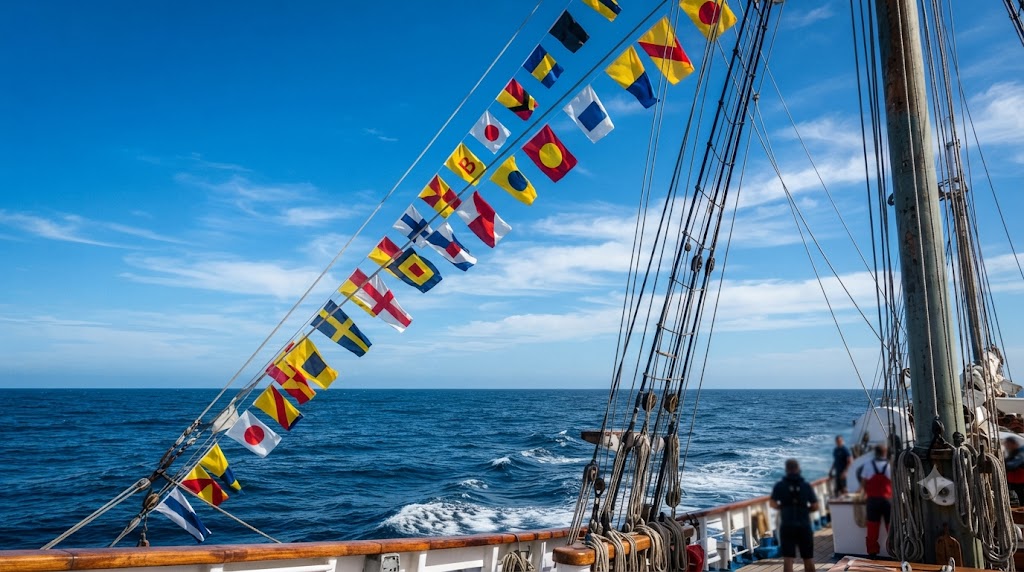
1. The Genesis of Universal Ocean Communication
For centuries, maritime navigation was plagued by a fatal linguistic barrier. When ships of different nationalities encountered each other amid roaring gales, treacherous shoals, or naval engagements, acoustic hailing was impossible, and crew members rarely shared a common spoken language. A French merchant ship struck on a sandbank could not articulate its distress to an approaching British frigate or Danish schooner. Miscommunication at sea cost thousands of lives and millions in lost cargo every year.
In 1855, the British Board of Trade drafted the foundation of the Commercial Code of Signals, which evolved through international diplomatic conventions into the International Code of Signals (ICS), administered today by the International Maritime Organization (IMO). The ICS is a universal visual language consisting of 40 specialized geometric flags capable of transmitting complex navigational warnings, medical diagnoses, tactical maneuvers, and emergency distress messages across open water without relying on spoken words or electronic power.
2. The Anatomy of the Signal Flag Alphabet
The modern ICS inventory consists of 40 distinct flags, categorized by geometric shape and functional role:
- 26 Alphabetical Flags: Rectangular flags (with two swallow-tailed exceptions) representing letters A through Z.
- 10 Numeral Pendants: Elongated trapezoidal pennants representing numbers 0 through 9.
- 3 Substitutes (Repeaters): Triangular pennants enabling a ship to spell words containing repeating letters with only one standard flag locker kit.
- 1 Answering Pendant: Red-and-white vertically striped pennant used by receiving vessels to acknowledge signals.
3. Single-Letter Emergency and Tactical Signals
While combinations of flags can spell out words or dictionary codebook entries, individual signal flags carry single-letter urgent meanings of paramount importance to maritime safety:
In historical maritime lore, the solid yellow flag (Quebec) was flown when entering foreign ports to request customs health clearance. If a ship suffered from yellow fever, cholera, or plague, it was forced to fly the “Yellow Jack”, warning all other ships that the vessel was under strict quarantine and no one could board or disembark under penalty of gunfire.
4. The Optical Engineering of Signal Flags
The graphic patterns of maritime signal flags are masterpieces of functional optical engineering. Because flags must be read through brass telescopes over miles of salt spray, haze, and changing light, designers adhered to strict graphic constraints:
- High-Contrast Color Restraint: Only five colors are permitted across the entire system: Red, Blue, Yellow, Black, and White. No intermediate hues like green, orange, or purple are used, as green easily blends with seawater, and orange fades to pink.
- Bold Geometric Primitives: Every flag uses simple, high-visibility geometry: horizontal bands (Charlie), vertical bicolors (Hotel), diagonal divisions (Oscar), checkerboards (Uniform), saltires (Victor), or central diamonds (Foxtrot).
- Distinctive Silhouettes: The two most urgent maneuver flags—Alfa (Diver down) and Bravo (Explosives/Fuel)—are manufactured with swallow-tailed cuts (indented fly edges). Even in completely calm air when no wind is blowing, the swallow-tailed silhouette immediately distinguishes them from all rectangular flags.
5. Two-Letter Distress and Navigational Signals
When two signal flags are hoisted vertically together on a single halyard (read from top to bottom), they communicate specific navigational and distress situations codified in the IMO International Codebook:
6. “Dressing Overall”: Ceremonial Naval Protocol
On national holidays, royal anniversaries, and naval fleet reviews, warships and civilian vessels engage in the colorful ceremonial tradition known as “Dressing Overall” (or dressing ship). A long cable strung with signal flags is hoisted from the waterline at the bowsprit, up to the foremast head, across to the mainmast head, and down to the stern taffrail.
To prevent accidentally spelling embarrassing words, offensive insults, or tactical commands in foreign languages, naval regulations enforce rigid flag sequences. Navies use mathematical formulas alternating colors and shapes (e.g., two flags, one pendant, two flags, one pendant) to create an aesthetically magnificent chromatic canopy that contains zero intelligible phrases.
7. Frequently Asked Questions
Are maritime signal flags still relevant in the era of GPS, VHF radio, and satellite AIS?
Absolutely. International maritime law (SOLAS Convention) mandates that all commercial vessels over a certain tonnage carry a full locker of signal flags and an updated ICS codebook. Electronic systems, satellite transponders, and radios can suffer total electrical blackouts, generator fires, or cyber jamming; signal flags require zero electricity, functioning reliably in any maritime emergency.
What is the “Blue Peter” flag?
The Papa (P) flag—a blue square containing a white square in its center—is affectionately known in maritime tradition as the “Blue Peter.” When hoisted at the masthead while in harbor, it signals to crew and passengers: “All persons are to report on board immediately, as the vessel is about to proceed to sea.”
7. Admiral Togo’s Z Flag at the Battle of Tsushima (1905)
In the history of naval warfare, single maritime signal flags have commanded the fate of entire empires. The most celebrated instance in modern naval history occurred on May 27, 1905, at the Battle of Tsushima during the Russo-Japanese War. Japanese Admiral Togo Heihachiro aboard his flagship, the battleship Mikasa, prepared to intercept the Russian Imperial Navy’s Baltic Fleet.
At 1:55 PM, Admiral Togo ordered the Z Flag (Zulu: divided into four triangular quadrants of yellow, red, blue, and black) hoisted at the masthead. Under the pre-arranged battle orders of the Imperial Japanese Navy, the Z Flag telegraphed the immortal message:
“The fate of the Empire rests on this battle. Every man is expected to do his utmost.”
Inspired by Nelson’s famous Trafalgar signal, the hoisting of the Z Flag electrified the Japanese fleet, resulting in the total destruction of the Russian fleet and marking the first time in modern history that an Asian nation defeated a European great power in naval combat. The Z Flag remains a revered naval relic in Japan to this day.
8. Flaghoist vs. Semaphore vs. Morse Code at Sea
During the 19th and 20th centuries, naval signaling utilized three complementary non-electronic communication channels:
9. Yacht Racing and Regatta Flag Signaling
In competitive sailing, the International Code of Signals is integral to the Racing Rules of Sailing (RRS) administered by World Sailing. Regatta race committees use signal flags accompanied by sound signals (horns or cannon shots) to govern starts, postponements, and disqualifications:
- Class Flag: Hoisted 5 minutes before start as the Warning Signal.
- Papa Flag (Blue Peter): Hoisted 4 minutes before start as the Preparatory Signal.
- Black Flag (Rule 30.4): The severe “Black Flag Rule”—any boat over the starting line during the final minute before the gun is instantly disqualified without a hearing.
- Answering Pendant (AP): Races postponed; all competitors stand by for further instructions.
Global Vexillological Preservation: Institutional Archives, Legal Protections, and Heraldic Authorities
To preserve national standards and historic banners for future generations, sovereign nations maintain dedicated statutory bodies, heraldic colleges, and state archives. Studying how international institutions document, restore, and legally protect flag heritage reveals the profound cultural reverence accorded to vexillological artifacts worldwide.
A. The College of Arms and the Court of the Lord Lyon
In the United Kingdom and the Commonwealth, the granting and regulation of flags is administered by the College of Arms in London (established by King Richard III in 1484) and the Court of the Lord Lyon in Edinburgh, Scotland. In Scotland, the Lord Lyon King of Arms possesses judicial power under ancient acts of the Scottish Parliament: displaying an unauthorized or historically defective coat of arms or banner on a public building is a criminal offense, prosecutable in the Lyon Court.
B. The Flag Research Center and FIAV International Congresses
Founded in 1962 by Dr. Whitney Smith, the Flag Research Center pioneered the scientific methodology of modern vexillology. Together with the Fédération Internationale des Associations Vexillologiques (FIAV), uniting over fifty regional associations across six continents, scholars convene biennially at the International Congress of Vexillology (ICV) to debate historical flag discoveries, coordinate flag conservation science, and standardize digital vexillological taxonomy.
C. Constitutional Flag Protection Laws and Degradation Etiquette
National flag codes around the world mandate specific dignified procedures for retiring soiled or damaged standards. In the United States (4 U.S.C. § 8k), when a flag is no longer a fitting emblem for display, it should be destroyed in a dignified manner, preferably by burning during a respectful solemn ceremony. Similarly, the Flag Code of India (2002) mandates that damaged national flags must be destroyed privately in their entirety, preferably by burning or burying in accordance with sovereign dignity.
- Always hoist the national flag briskly to the peak and lower it ceremoniously with slow deliberation.
- Never allow a sovereign flag to touch the ground, floor, water, or objects beneath it.
- When flown alongside regional or corporate banners, the sovereign national flag always occupies the supreme position of honor.
- Never display a national flag upside down, except as a signal of dire medical or navigational distress.
- During half-mast mourning, first hoist the flag to the peak for an instant before lowering to half-staff.
- Illumination is required if a flag is displayed outdoors during the hours of darkness.
- Do not place advertising slogans, signatures, or unauthorized badges directly upon the field of a national standard.
- Store flags folded neatly in clean, moisture-free cases to prevent mold, fabric oxidation, and pest damage.
- When multiple foreign flags fly together, each must fly on its own staff of equal height and identical scale.
- Retire worn, faded, or frayed flags privately with dignity and reverence.